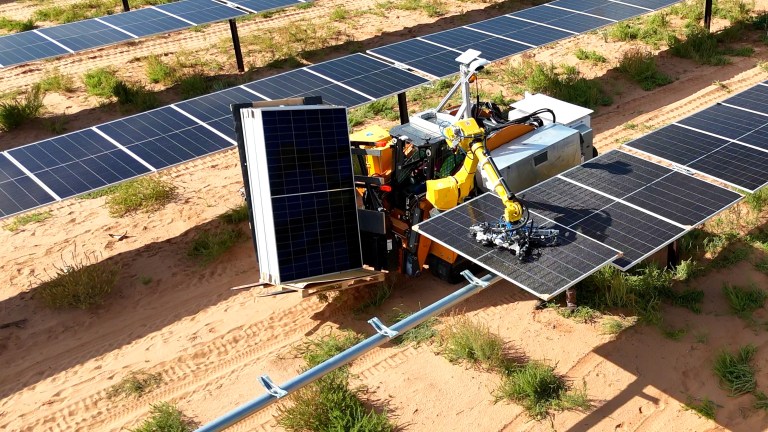
As solar farms scale from hundreds of acres to thousands, the industry is running into a stubborn bottleneck: people. Developers can secure land, panels, and financing, but finding enough workers to install millions of modules in remote fields is increasingly difficult. A young robotics company called Gritt is betting that artificial intelligence can close that gap.
Founded by Carnegie Mellon–trained roboticists Puneet Puri and Vishal Dugar, Gritt has emerged from stealth with $34 million in funding to automate some of the most grueling tasks on solar construction sites. The company’s pitch is simple but ambitious: use AI-driven robots to move, position, and eventually assemble solar infrastructure at industrial scale, then apply the same technology to the rest of construction.
Instead of designing bespoke machines, Gritt relies on off-the-shelf hardware such as rented skidders and industrial robotic arms from established manufacturers. Its value lies in the software layer: perception, planning, and control models that allow these machines to operate in chaotic outdoor environments, where terrain, weather, and workflows change constantly.
Today, Gritt’s systems focus on one of the most repetitive jobs in utility-scale solar: handling large glass panels. The robots unload pallets, carry panels across uneven ground, and place them onto metal racks with sub-millimeter precision so human crews can secure them. On sites where a traditional eight-person crew might install about 800 panels a day, Gritt says the same crew, paired with its systems, can reach 3,000 to 4,000 panels.
Two systems are already working in the field, feeding data back into Gritt’s models to refine performance. The company says it is contracted to assist with the installation of 2.8 gigawatts of solar capacity over the next 18 months and is working with several of the largest power construction firms in the United States. It aims to have 48 systems operating within six months.
Gritt faces competition from startups building dedicated solar-installation robots, but its founders argue that a software-first, hardware-agnostic approach will scale faster and more cheaply. They are already training their system to take on additional tasks such as fastening panels, drilling posts, assembling racking, and, eventually, tying rebar and performing other labor-intensive jobs across construction.
The long-term vision is a “physical AI” layer on job sites: robots that not only perform dexterous work but also act as roaming sensors, spotting safety issues, tracking inventory, and giving managers a real-time, machine’s-eye view of how projects are unfolding.