(Part I: The Stretch of Her Arrival)
The whispers say she was born beneath a Carolina moon that throbbed like an old bruise on the skin of the sky.The year was 1865—when chains were breaking like brittle teeth and ghosts of plantation songs still limped through the air. Her mother; a woman of quiet thunder, pushed her into the world with a scream that shook the birthing floorboards, a scream not of pain but of prophecy.
She came out too long.
Too long for the hands that caught her.
Too long for the sighing cot.
Too long for the shadow that whispered, “That one’s not all here.”
Her mama named her Ella, which in tongues older than English meant "torch" or "other" or “light birthed in dusk.”
But the elders called her something different when they thought she couldn’t hear:
“The Bone Tall One.”
Ella did not grow like other children. She stretched. She elongated. She rose.
By seven she was taller than her uncles. By twelve, the trees near the house seemed to bow to her. Her limbs were ladders. Her back a spine of mountain ridges. Her voice deepened into a hum like roots talking underground.
And with every inch she climbed, the townspeople stared harder, more afraid.
One whispered, “She was kissed by a spirit.”
Another, “She ain’t right. That girl’s some kind of Dahomey conjure.”
The preacher simply said, “God’s mistake. Keep her humble.”
But Ella—child of broken chains—would not shrink. Not in prayer. Not in corset. Not even in the hollering wind.
Her mama, knowing how cruel men got when confused, taught Ella the arts of invisibility.
Not vanishing, no. But the other kind: camouflage of presence.
She walked soft. Spoke slow. Bent knees when asked.
Yet even crouched, Ella could not disappear.
She was taller than forgiveness, wider than myth, and brighter than the eyes allowed themselves to accept.
At seventeen, she had her first dream of the mirrors.
Not real ones; soul mirrors—held by a shadowed crowd in a circus not made of tents but bones and breath. Each mirror reflected a version of her: Empress, Soldier, Tower, Witch.
All taller than the sky.
In the dream, a woman with lion eyes and Dahomey scars whispered,
“You are not from here. You are from the between.”
Ella awoke crying. Not from fear. From recognition.
One hot afternoon, a traveling man arrived.
He was small and snake-thin, with a voice like a sermon that didn’t believe itself. Called himself Mr. Tibbs, a scout from a show that stretched from Kansas to Kingdom Come.
He watched her lift a basket of apples and nearly dropped his spectacles.
“You ever consider—show business?”
Ella blinked slow.
“You mean a freak show.”
He smiled like oil.
“I mean the stage, dear lady. The world! You'd make more money than ten white bankers and never scrub another floor again.”
Her mama tightened her jaw like a fist. But Ella looked out the window—at the same dirt road she’d walked since childhood—and imagined herself taller than geography. She went.
(Part II: The Invention of Madam Abomah)
They dressed her in silks and lies.
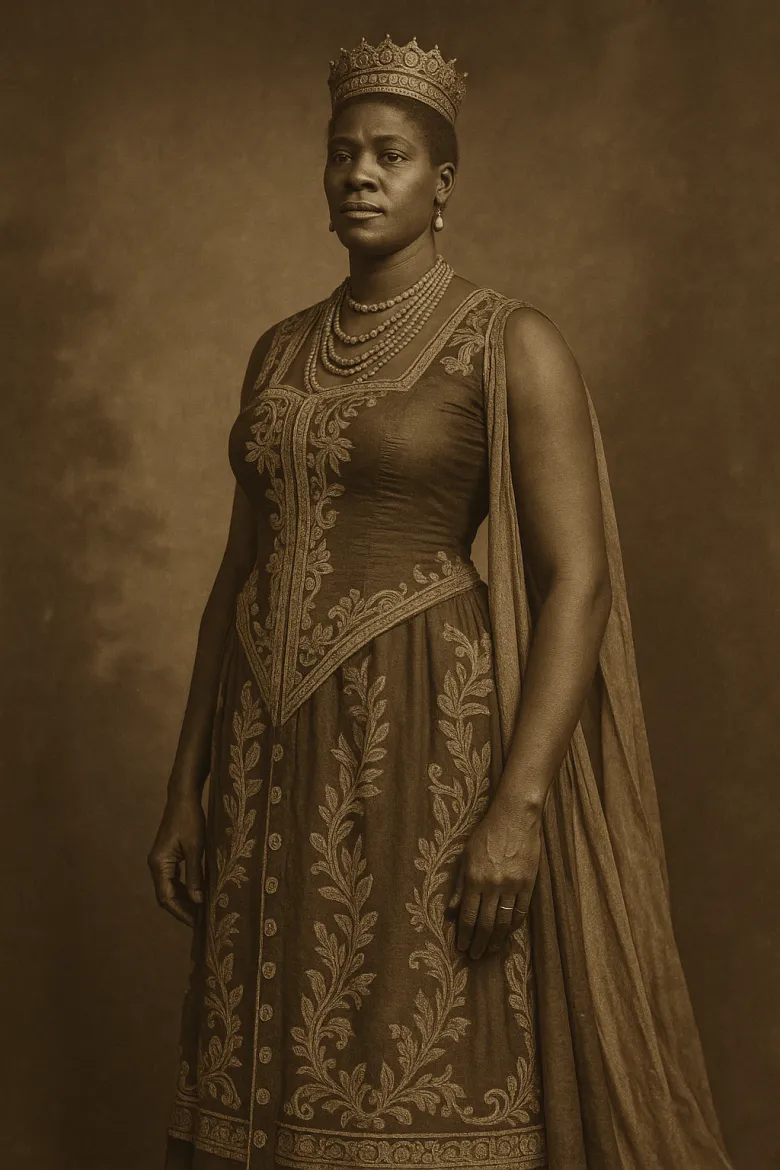
Told her she was now “Madam Abomah”, Queen of the Amazons, direct from Dahomey.
Told her to roar.
To stand barefoot.
To let them gawk.
To smile, always, and never look down—for fear it might remind the audience they were less.
She did not speak in Dahomey tongue, but her silence was royal.
She did not rage, but her gaze cracked vanity like old china.
She stood with elegance so cutting it turned gawkers into believers.
They thought they made her.
But it was she who conjured them; her audience into their place.
She crossed oceans in gowns laced with secrets.
Danced in theaters that once barred Black breath.
Spoke to queens who mistook her for spectacle, not sorcery.
In Liverpool, a woman fainted just by looking up at her.
In Paris, she was kissed on the gloved hand by a painter who claimed she’d visited him in a dream.
Men fell in love.
Women fell in envy.
Children fell into stories.