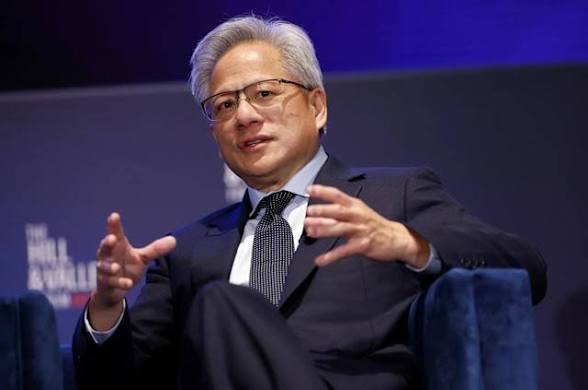
As anxiety over artificial intelligence ripples through workplaces, Nvidia chief executive Jensen Huang is pushing a very different narrative: AI, he argues, is not a job destroyer but a powerful engine for new employment and industrial renewal.
In a wide-ranging conversation with MSNBC’s Becky Quick at a Milken Institute event, Huang rejected the idea that AI will trigger mass unemployment or a permanent underclass of displaced workers. Instead, he framed the technology as the backbone of a new industrial era, one that demands vast physical and human infrastructure.
“AI creates jobs,” Huang said, calling it the United States’ best chance to “re‑industrialize” its economy. He pointed to the sprawling ecosystem required to build and run AI systems: advanced chip fabrication plants, data centers, power and cooling facilities, specialized logistics, and the software and services layered on top. Each of those, he stressed, requires skilled workers in engineering, construction, operations, and maintenance.
Huang’s optimism stands in contrast to mounting fears that rapid automation will deepen inequality. Quick pressed him on whether the speed of AI adoption could cause a more severe dislocation than past technological shifts. Huang responded by drawing a sharp line between “tasks” and “jobs.”
Automation, he argued, typically targets specific tasks within a role, not the entire role itself. People who assume otherwise “misunderstand that the purpose of a job and the task of a job are related” but not identical, he said. In his view, AI will increasingly handle routine or repetitive work, while humans move up the value chain to more creative, interpersonal, and judgment-based responsibilities.
Huang also criticized what he called “science fiction stories” about AI dominating humanity or wiping out whole sectors of the economy. His worry is not that AI will become too powerful, but that exaggerated doom scenarios will scare workers and voters away from engaging with the technology at all.
That caution comes as economists and consultancies publish sharply divergent forecasts. Some studies suggest a significant share of U.S. jobs will be reshaped or eliminated by AI, even as new categories of work emerge. For Huang, the outcome hinges less on the technology itself than on whether businesses, educators, and policymakers move quickly to retrain workers and build the industrial base he believes AI makes possible.