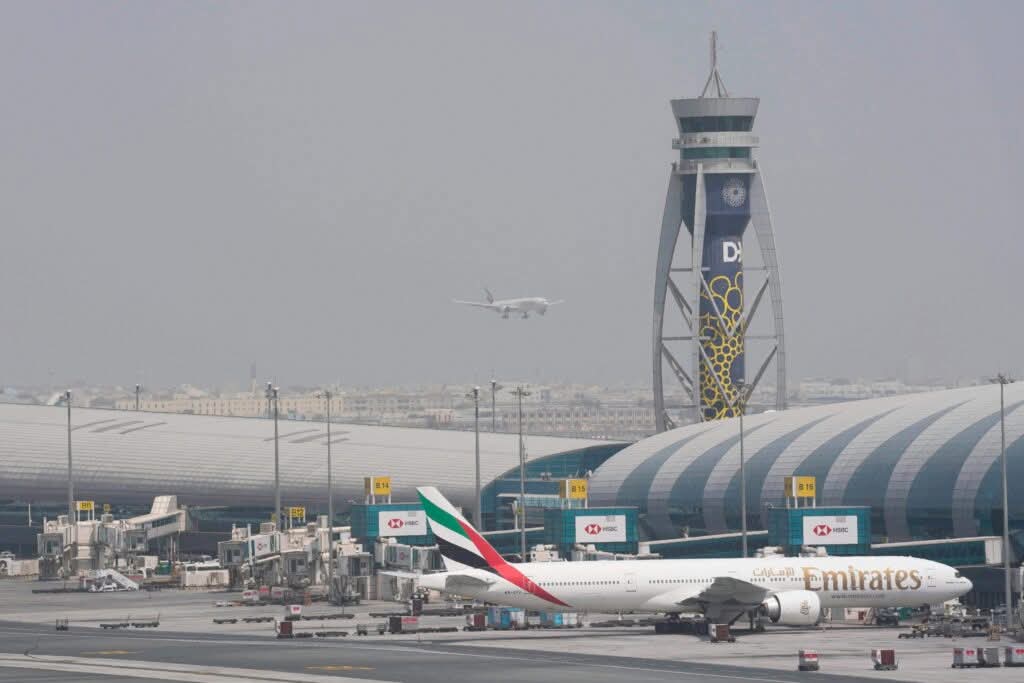
Drones crashed near Dubai International Airport, injuring four people and briefly disrupting operations at one of the world’s busiest aviation hubs, as a wave of attacks rippled across the Gulf and the Strait of Hormuz.
The incidents form part of what regional officials and analysts describe as an intensifying Iranian campaign aimed at pressuring the United States and its allies by targeting both military and civilian infrastructure. The strategy has zeroed in on the oil-rich Gulf, where energy facilities, airports and shipping lanes are tightly clustered and acutely vulnerable.
Maritime security monitors reported that a container ship and a bulk carrier were struck by unidentified projectiles off the coast of the United Arab Emirates, one near Dubai and another off Ras Al Khaimah. A third vessel was hit in the Strait of Hormuz, off Oman, sparking a fire that was later brought under control. No group immediately claimed responsibility, but Western and Gulf officials privately blamed Iran or its proxies, citing the pattern of recent attacks.
The Strait of Hormuz, a narrow chokepoint between Iran and the Arabian Peninsula, carries nearly a fifth of the world’s oil. Even limited disruptions there can send shockwaves through global energy markets, and traders have already been rattled by sharp price swings as reports of new incidents emerge.
Across the region, air defenses have been on high alert. Saudi Arabia said it intercepted drones aimed at the Shaybah oil field, a linchpin of its crude production, and shot down seven ballistic missiles targeting its eastern region and the Prince Sultan Air Base. Explosions were also reported over Qatar, while the UAE confirmed additional attempted strikes on its territory.
Energy infrastructure has been repeatedly in the crosshairs. Saudi Aramco’s vast Ras Tanura complex, one of the Middle East’s largest refining and export hubs, has come under attack, as has the UAE’s Ruwais refinery, among the biggest globally. In response to mounting security risks, QatarEnergy halted some operations and declared force majeure, a legal step signaling it may not meet export commitments. Producers in Kuwait have issued similar notices.
Regional diplomats warn that Iran’s apparent bid to knock key refineries offline while tightening its grip on the Strait of Hormuz is designed to maximize economic pain far beyond the Middle East, turning the Gulf’s energy arteries and air corridors into pressure points on the global economy.