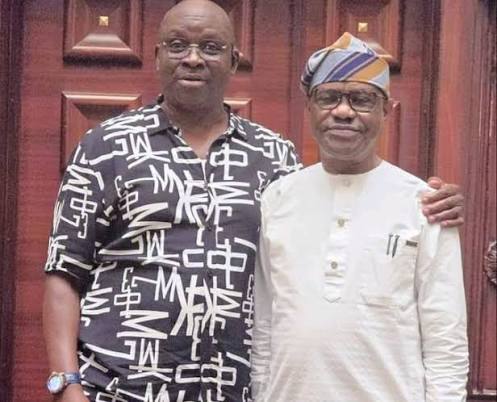
Former Ekiti State governor Ayodele Fayose has declared that President Bola Ahmed Tinubu is unlikely to abandon the Minister of the Federal Capital Territory, Nyesom Wike, in favour of Rivers State governor Siminalayi Fubara, despite the deepening political crisis in Rivers State.
Speaking in a televised interview, Fayose argued that Wike’s political weight, his role in Tinubu’s emergence, and his current performance as FCT minister make him far more valuable to the president than Fubara, who has been locked in a bitter power struggle with his predecessor.
“The Asiwaju that I know will not get rid of a Wike for a Fubara. Wike came from Rivers to give support to President Tinubu,” Fayose said, insisting that the president has little incentive to side with the Rivers governor in the ongoing feud.
The rift between Wike and Fubara has fractured the political landscape in Rivers State, triggering impeachment moves, parallel loyalties within the state legislature, and a broader contest for control of the state’s political machinery. What began as a quiet disagreement over appointments and influence has evolved into one of the most consequential intra-party battles in Nigeria’s recent political history.
Fayose framed the crisis as a classic struggle over political structure and succession, noting that Wike, as a former two-term governor and power broker, is determined to retain influence over the state he once governed, while Fubara is seeking to assert his independence as an elected governor.
“The crisis originated from a power struggle over control of the state’s political structure, including the Peoples Democratic Party apparatus and the State Assembly,” he said, echoing widespread analysis that the conflict is less about ideology and more about who commands loyalty in Rivers politics.
The Rivers State House of Assembly has already initiated impeachment proceedings against Fubara, accusing him of gross misconduct. The allegations include the demolition of the Assembly complex, extra-budgetary spending, and disobedience to a Supreme Court ruling on legislative autonomy. The governor’s supporters insist the moves are politically motivated and orchestrated by forces loyal to Wike, a claim the Assembly has repeatedly denied.
Fayose, however, focused less on the legal details and more on the political calculus in Abuja. He stressed that Wike’s current position as FCT minister, combined with his track record of delivering votes, makes him indispensable to the ruling All Progressives Congress and to Tinubu personally.
“Wike is in Abuja performing; we’ve never had it so good in Abuja, even a blind man can’t deny that,” Fayose said, praising the minister’s high-profile infrastructure push in the capital. He linked that performance directly to Wike’s political capital within the presidency.
He went further, tying Wike’s influence to electoral outcomes. “The local government elections in Rivers, APC won them courtesy of Wike. The coming local government elections in Abuja, APC will still win them. So, what else will the President want from Wike?” he asked, suggesting that as long as Wike continues to deliver political dividends, Tinubu has no reason to distance himself from him.
Fayose’s comments also touched on reports that Governor Fubara had sought Tinubu’s intervention in the crisis, including travelling to meet the president outside the country. To Fayose, that move underscored Fubara’s political vulnerability rather than his strength.
“If Governor Fubara has gone to meet the President, then it shows he needs help. When you don’t praise God, when you refuse to humble yourself and look for peace, you’ll just be running helter-skelter. What he’s looking for is inside his pocket,” Fayose said, implying that Fubara should have prioritised reconciliation and internal negotiations before seeking external rescue.
His remarks reflect a broader sentiment among some political actors that Fubara mismanaged his relationship with Wike too early in his tenure, underestimating the former governor’s reach within both the Peoples Democratic Party and the federal establishment.
Beyond Rivers, Fayose used the interview to address the internal turmoil within the PDP, a party still reeling from its defeat in the last general elections and from the high-profile rebellion of some of its key figures, including Wike, who openly opposed the party’s presidential candidate.
He rejected suggestions that President Tinubu is the architect of the PDP’s woes, insisting that the opposition party’s problems are largely self-inflicted.
“The challenges in the PDP are not the fault of Asiwaju,” Fayose said. “Failure in my home, God forbid, is not the fault of my neighbour.”
He described the PDP as a party weakened by internal sabotage, unresolved grievances, and a failure to manage ambition. “The PDP caused themselves an insurrection. It’s a house that is divided against itself, and the nature of man is survival of the fittest,” he added.