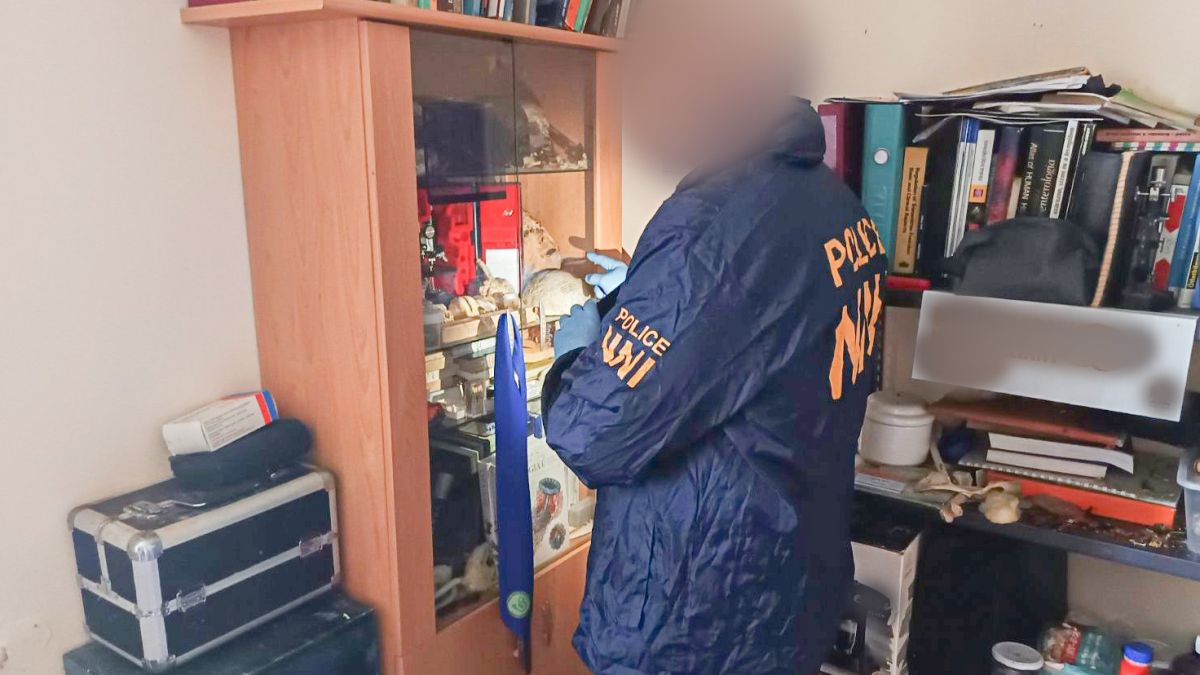
Hungarian investigators say a self-confessed cannibal has been arrested after officers allegedly discovered human body parts, bones and preserved tissue stored in his Budapest home and workplace.
The 30-year-old suspect, described by police as “passionate about anatomy and pathology,” was detained by Hungary’s National Bureau of Investigation following a tip that he was keeping human remains. Detectives searched his apartment and reportedly uncovered skulls, a complete lower leg, a hand and a reconstructed human face fashioned from facial skin. Additional bones were said to have been packed into a suitcase.
Officers also reported finding a heart preserved in a jar. Forensic specialists are now examining it to determine whether it is human or animal, as well as attempting to identify the origin of all the recovered remains.
During questioning, the man allegedly admitted that his interest in human anatomy had escalated into an obsession. According to police, he confessed to collecting specific body parts that particularly attracted him, and went further, stating that he had prepared food from some of the remains and eaten them.
Investigators suspect the body parts were obtained through two main channels: his work in hospitals, where he may have had access to corpses or medical waste, and illicit exhumations in “abandoned cemeteries in Slovakia and Hungary.” Authorities believe he may have targeted neglected graveyards where oversight is minimal and security is weak.
The suspect is currently being held on suspicion of the illegal use of human bodies, a serious offense under Hungarian law. Police have not ruled out additional charges, which could follow once forensic examinations and digital analyses are complete.
Officers have seized his computers, laptops, tablets, mobile phones and data storage devices in an effort to trace his activities, potential communications with others and any evidence of planning or documenting the alleged crimes. Investigators are also working to determine whether any of the remains can be linked to specific individuals or missing persons cases.
Forensic experts now face the painstaking task of cataloguing and analyzing each fragment of tissue and bone. Authorities say the results will be crucial in establishing how many victims are involved, where the remains originated and whether the suspect acted alone or as part of a wider network.