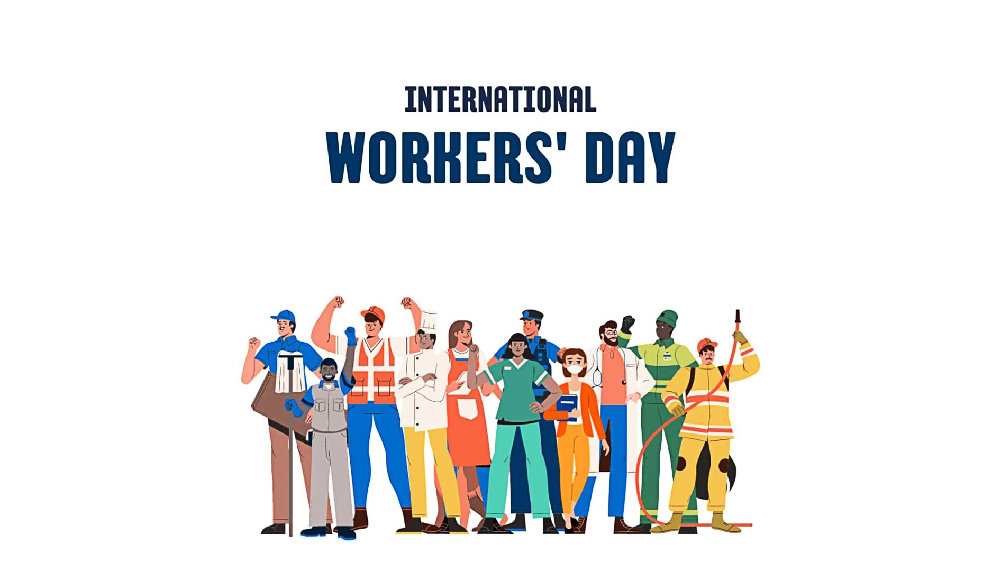
Every year on the 1st of May, Nigeria joins the rest of the world to mark Workers' Day, a date rooted in the global labour movement's long fight for dignity, fair wages, and humane working conditions. Banners go up. Speeches are delivered. Trade union leaders take the microphone. And by evening, we return to the same desks, the same unresolved salaries, the same country.
But something is shifting beneath the surface, quietly, stubbornly, and with growing urgency.
The Nigerian worker is not who she used to be.
From Factory Floors to Phone Screens
The original Workers' Day was born out of industrial-age struggle, workers demanding eight-hour days in factories that treated them like machines. That world was legible. You had an employer. You had a punch card. You had a union.
Today, millions of Nigerians, especially the young, work without any of that scaffolding. A 26-year-old in Lugbe wakes up, opens three apps, and has already started her workday before anyone has said "good morning." A graduate in Enugu is managing a client's social media in Canada, taking a virtual course from a platform in the US, and building a side business simultaneously, all from the same room where he sleeps. A corp member serving in Kano is learning digital skills on weekends, positioning herself for a market that didn't exist when her parents graduated.
These are workers. They are building Nigeria's economic fabric, one gig, one post, one startup at a time. But the system barely sees them.
The Dignity Gap
Here is what is rarely said plainly on Workers' Day: Nigeria has a dignity gap in the world of work.
Millions of Nigerians work extraordinarily hard. Not out of passion alone, but out of survival. Out of duty to families, to communities, to dreams they refuse to abandon. They work through unreliable power. They work through inflation that swallows their earnings before the month ends. They work in formal offices that have not paid their salaries in months, and in informal markets where there is no minimum wage, no health plan, and no structure.
They are not lazy. They are not disorganised. They are workers operating in a system that has not kept pace with their ambition.
The infrastructure of work in Nigeria, power, internet connectivity, financial access, policy support, remains frustratingly inconsistent. A digital entrepreneur cannot build a stable business on four hours of NEPA power and a fluctuating exchange rate. A young graduate cannot commit to formal employment when the salary offered in 2026 reflects the thinking of 2005.
We celebrate workers today. But celebration without reform is theatre.
The New Work Ethic Nobody Is Talking About
There is, however, a story worth telling loudly this Workers' Day.
The Nigerian youth is not waiting.
Against every structural headwind, a generation of self-made workers is emerging, one that has redefined what labour means. They are building businesses from borrowed capital and borrowed time. They are acquiring skills through free courses, WhatsApp mentors, and sheer stubbornness. They are creating content, coding applications, training communities, writing books, running campaigns, managing remote teams, and doing it without a formal job title or a certificate of permission.
This is not hustle culture for its own sake. This is intelligent, adaptive, purposeful labour, born from necessity, but shaped by vision.
In NYSC camps across the country, young Nigerians are sitting through SAED workshops not just to fulfil requirements, but genuinely searching for a pathway. In polytechnics and universities, students are launching businesses before they collect their degrees. In markets and media houses, in co-working spaces and church halls, Nigerians are working, and working hard.
They deserve more than survival.
What Workers' Day Should Actually Mean in Nigeria
Let me be direct: Workers' Day in Nigeria should not just be a day of marches and remarks. It should be a national moment of reckoning.
A reckoning about what we owe to those who build this country daily without recognition, the informal traders, the remote freelancers, the young entrepreneurs, the teachers in underfunded schools, the health workers stretching thin resources, the farmers who still can't access markets efficiently.
It should be a day to ask hard questions:
Why are millions of graduates entering a job market that cannot absorb them, and yet we have not aggressively built the infrastructure to support self-employment and enterprise?
Why does a Nigerian digital entrepreneur still face bureaucratic friction that would make a counterpart in Rwanda or Kenya marvel in disbelief?
Why do we mark Workers' Day but rarely discuss the reform of labour laws to protect the gig economy worker, the freelancer, the creative professional?
And most importantly, what are we prepared to do differently?
A Word to the Workers
To every Nigerian who showed up today, whether to a formal office, a market stall, a laptop, a farm, or a training room, this is for you.
Your labour is not invisible, even when the system makes you feel that way. Every invoice you send, every class you teach, every product you create, every service you render with integrity is a form of nation-building. The Nigeria that will work is the one being quietly assembled by people like you, not waiting for rescue, but building while waiting for the conditions to improve.
Do not stop.
Do not let the dysfunction of systems diminish the significance of what you are building. And do not mistake survival for failure, many of the world's most transformative businesses, ideas, and movements were born under pressure.
But also: demand better. Demand policy that sees you. Demand structures that protect your labour. Demand leaders who understand that the economy is not a statistic, it is the daily reality of every Nigerian who wakes up and chooses to contribute.
The Work Continues
10