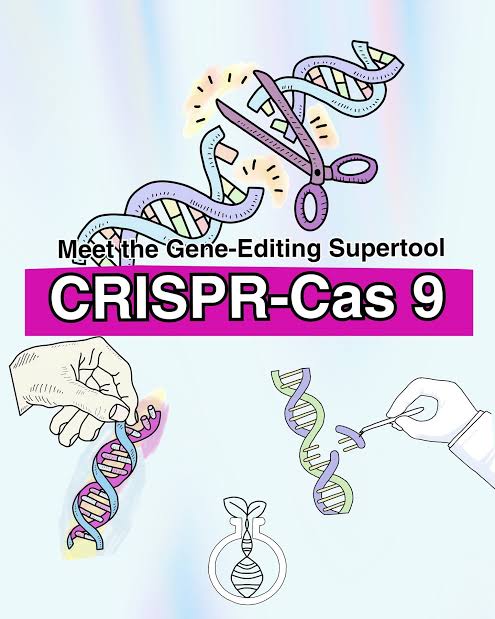
The Revolutionary Power of CRISPR-Cas9 Gene Editing:
Rewriting the Code of Life
Science and technology have always moved forward through bold leaps. Few leaps in the last fifty years have been as breathtaking as the discovery and development of CRISPR-Cas9 gene editing. In less than two decades, this tool has transformed from a curious bacterial defence system into a precise molecular scalpel that can rewrite DNA the very instruction manual of life. It is, without exaggeration, one of the most powerful technologies ever created by humankind.
What exactly is CRISPR-Cas9?
CRISPR stands for “Clustered Regularly Interspaced Short Palindromic Repeats.” In nature, bacteria use this system like an immune memory: when a virus attacks, the bacterium stores a piece of the virus’s DNA and later uses an enzyme called Cas9 to recognise and cut any matching viral DNA that invades again.
In 2012, scientists Jennifer Doudna and Emmanuelle Charpentier realised they could reprogramme this natural defence mechanism. They could now design a short “guide RNA” that tells Cas9 exactly where to cut in any organism’s genome. Once the DNA is cut, the cell’s own repair machinery can be guided to delete, replace, or insert new genetic code with astonishing accuracy. The entire process is cheap, fast, and works in almost every living thing from bacteria to humans.
Real-world breakthroughs that prove its power
- In 2019, the first CRISPR-based treatment (for sickle-cell disease and beta-thalassemia) entered clinical trials. By 2023, the FDA and EMA had approved Casgevy the world’s first CRISPR therapy allowing patients who once faced lifelong pain and blood transfusions to live essentially normal lives.
- In 2024–2025, researchers used CRISPR to restore vision in patients with inherited blindness (Leber congenital amaurosis). Some patients who had never seen colour could now recognise faces.
- Agriculture has already benefited: CRISPR-edited mushrooms that do not brown, rice with higher yields and better nutrition, and pigs resistant to a deadly virus have all reached the market or advanced trials.
- In 2025, scientists successfully edited multiple genes in human embryos to remove hereditary heart conditions work that is still heavily regulated but shows the technology’s potential to eliminate genetic diseases before birth.
Why this aspect of science and technology is exciting?
CRISPR is not just another lab tool; it gives us direct control over evolution. For the first time in history, we can cure diseases at their genetic root instead of merely treating symptoms. Imagine a world without sickle-cell anaemia, cystic fibrosis, Huntington’s disease, or certain cancers. That world is no longer science fiction it is in clinical trials today.
Beyond medicine, CRISPR is accelerating basic research at an unbelievable pace. Want to study what a particular gene does? Edit it out in a mouse in weeks instead of years. Want to understand human evolution? Edit ancient DNA sequences back into modern cells. The speed and cost (a single CRISPR experiment can now cost less than a cup of coffee) have democratised genetic engineering. Universities, small labs, and even high-school students in some countries are now conducting experiments that once required millions of dollars and huge teams.
Challenges and ethical questions we must face
With great power comes great responsibility. CRISPR raises serious ethical issues:
- Germline editing (changes passed to future generations) could eliminate diseases but also opens the door to “designer babies.”
- Off-target effects (cutting the wrong place in the DNA) are now extremely rare with improved versions like prime editing and base editing, but not zero.
- Access and equity: Will this technology only be available to wealthy nations and rich families, or can it be made affordable globally?
These are not abstract debates. In 2018, the controversial case of the “CRISPR babies” in China showed how quickly the technology can be misused. International guidelines and strict regulations are now being developed, but the conversation must continue.
The road ahead
By 2030, experts predict dozens of CRISPR therapies will be approved. Newer versions prime editing, base editing, and CRISPR-Cas12 and Cas13—are even more precise and can edit RNA directly. Some researchers are already using CRISPR to fight climate change by engineering bacteria that capture carbon more efficiently or crops that grow in salty soil. The same tool that can cure blindness could one day help restore coral reefs or clean polluted rivers.
Conclusion
CRISPR-Cas9 is more than an aspect of science and technology; it is a turning point in human history. It marks the moment we stopped being passive observers of our genetic destiny and became active authors of it. The technology is still young barely thirteen years old in its modern form yet it has already saved lives, fed millions, and opened doors we never knew existed.
As students of science and technology, we are privileged to witness and shape this revolution. The question is no longer “Can we edit genes?” but “How responsibly and equitably will we use this power?” The answer we give will define the next chapter of human progress.