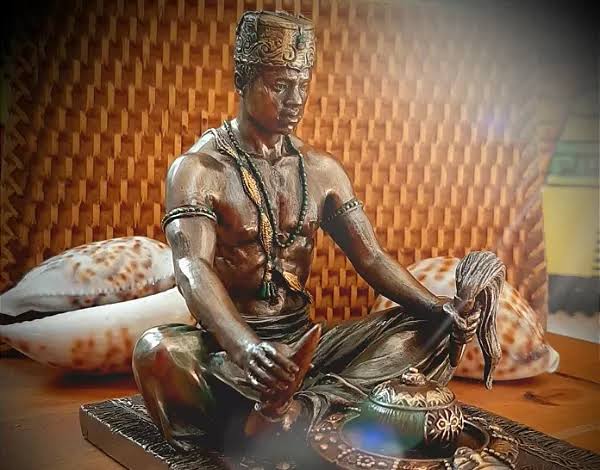
Long ago, in the ancient city of Ile‑Ife, the great sage Orunmila was known as the keeper of wisdom. Through the sacred system of Ifá, he guided kings, farmers, traders, and warriors. When people were confused about life, destiny, or the future, they went to the priests of Ifá, the Babalawo, who interpreted the messages of Orunmila.
In those days, people believed deeply that destiny was something chosen before birth and that wisdom came from listening carefully to the teachings preserved in the Odu Ifá. Life moved slowly, and guidance was sought with patience.
.jpg?alt=media&token=00bba5c8-6d1a-424f-ae00-b23e7ca4db9b)
Odu Ifá
But time changed.
Centuries passed. Cities grew taller, roads busier, and knowledge spread through books, schools, and glowing screens. In modern Nigeria and across the world, many people began to see life differently. Some believed that science explained everything. Others followed different religions or philosophies. Many no longer visited the Babalawo before making decisions. Instead, they searched the internet, read self-help books, or trusted their own logic.
One might imagine that Orunmila, the ancient keeper of wisdom, would look upon the modern world with quiet curiosity. He would see people endlessly scrolling through streams of information, studying data, trends, and technology in their effort to understand what lies ahead. Yet, beneath all these modern tools, they would still be chasing the same answer humans have always sought, a deeper understanding of their destiny.
“Humans have not changed as much as they think,” “Only the tools have changed.”
Where ancient people cast sacred palm nuts to seek answers, modern people analyze statistics and algorithms. Where elders once told stories to guide the young, now podcasts and digital voices do the same. Yet the questions remain the same: Why am I here? What should I do? What does the future hold?
Some people still follow the old traditions of Ifá faithfully. Others respect them as part of cultural history. And some reinterpret Orunmila not only as a deity, but as a symbol of wisdom, the reminder that knowledge, patience, and reflection are needed to live well.
In this way, Orunmila lives in two worlds:
the ancient world of sacred verses and the modern world of new beliefs.
And perhaps the lesson of the old sage is simple:
No matter the age, humans will always seek wisdom, whether from divination, philosophy, science, or experience.
Because the search for meaning never truly ends.