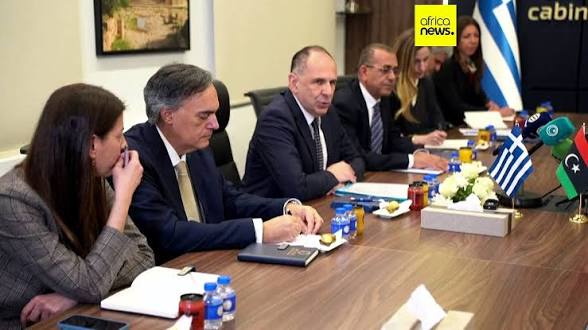
Greek Foreign Minister Giorgos Gerapetritis received a notably warm welcome in Tripoli as he began a high-stakes visit aimed at resetting relations with Libya and tackling shared challenges in the Mediterranean.
Gerapetritis held talks with Libyan Foreign Minister Taher al-Baour focused on three interlocking issues: the surge in irregular migration from eastern Libya toward Greece, the long-running dispute over maritime boundaries, and the potential for deeper economic cooperation.
Athens has been alarmed by the sharp increase in migrants and asylum seekers departing Libya’s eastern coast and arriving on Greek islands. Greek officials argue that better coordination with Libyan authorities is essential to curb smuggling networks and prevent dangerous sea crossings.
Libyan officials said the ministers agreed that migration management must be addressed through a comprehensive approach, combining burden-sharing, enhanced border security and targeted training programs for Libyan services. Both sides framed the issue as a regional challenge affecting the entire Mediterranean basin rather than a purely bilateral dispute.
The talks also delved into economic opportunities, with particular emphasis on energy, infrastructure and maritime transport. Al-Baour said the two delegations examined “numerous aspects of economic cooperation” and agreed to promote direct contacts between Greek and Libyan business communities.
According to Libyan officials, the ministers endorsed plans for reciprocal visits by business delegations to explore joint ventures and long-term partnerships, especially in sectors linked to reconstruction, port development and offshore resources.
During his visit, Gerapetritis also met Abdulhamid Dbeibah, head of Libya’s internationally recognised Government of National Unity. Their discussions revisited the sensitive question of maritime border demarcation in the energy-rich waters south of Crete, an issue that has strained ties since rival agreements and claims were advanced in recent years.
Both sides reiterated their stated commitment to pursue a “constructive dialogue” on maritime zones, pledging to work within the framework of international law and to avoid steps that could further destabilise the region.
Diplomatic sources described the visit as an attempt to move beyond years of tension and to anchor relations in practical cooperation, even as fundamental disagreements over maritime rights and security responsibilities remain unresolved.