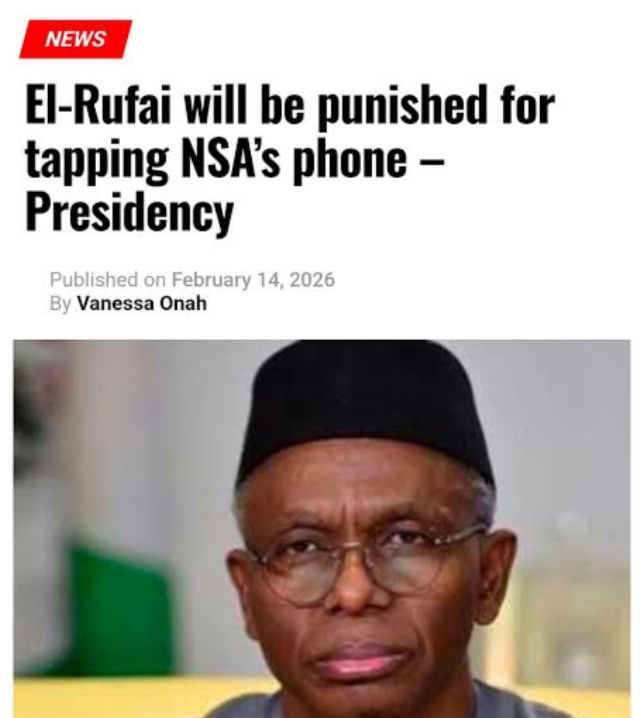
The prosecution of former Kaduna State Governor Mallam Nasir El-Rufai over allegations that he unlawfully accessed and discussed the telephone communications of Nuhu Ribadu, Nigeria’s National Security Adviser (NSA), has become a focal point of public debate. The charges, filed at the Federal High Court in Abuja by the Department of State Services (DSS), stem from comments El-Rufai made during a televised interview on Arise TV on 13 February 2026. In that interview, he claimed he and others “listened to conversations from Ribadu’s phone after it was tapped” and he heard instructions allegedly directing his arrest.
The Federal Government’s charge sheet includes three counts. First, it alleges that El-Rufai admitted to unlawfully intercepting the NSA’s communications, contrary to the Cybercrimes (Prohibition, Prevention, etc.) Amendment Act 2024. Second, it says he knowingly associated with persons involved in the interception and failed to report them. Third, it claims the act breached provisions of the Nigerian Communications Act 2003, compromising public safety and national security.
Central to this unfolding drama is the legal principle that the burden of proof lies squarely with the prosecution. Under Nigerian law, a person charged with an offence is presumed innocent until proven guilty beyond reasonable doubt. The prosecution must adduce credible, admissible evidence to establish the allegations. Evidence must be scrutinised in court, examined for legality and probative value, and subjected to cross-examination. The court’s role is not to assume guilt but to assess whether the prosecution has discharged its burden. Until such proof is established in open court, the defendant remains innocent in law.
Prosecuting El-Rufai for alleged wiretapping also holds bigger implications for national security and for the public trust in the country’s security architecture — particularly the office of the NSA. That office is constitutionally charged with coordinating national security and advising the President on threats and responses. When allegations surface that the top security coordinator’s own communications were accessed without legal authority, it raises questions about whether the NSA’s protective mandate was effective at that moment. If the prosecution ultimately proves that the NSA’s communications could be intercepted by actors outside lawful oversight, it would signal a failure of the NSA’s core duty to safeguard sensitive state information.
In this context, a successful prosecution of El-Rufai may be interpreted as a de facto vote of no confidence in the ability of the NSA and related security agencies to protect the nation’s highest communications. Confidence in national security bodies depends on the perception that they can secure classified channels and prevent unauthorised access. Proving unlawful interception of the NSA’s communications — even by third parties — indicates a breach in safeguards that are central to national stability.
Should the prosecution succeed, it would compel a re-examination of security protocols and oversight mechanisms within the NSA’s purview. Nigerians will ask not only whether El-Rufai committed a crime but why the nation’s security apparatus allowed such a breach to occur in the first place. The case, therefore, is not merely about an individual’s conduct; it is about systemic resilience and the public’s confidence in institutions entrusted with protecting state secrets.
The courts must approach the evidence without prejudice, ensuring that technical claims about phone interception are clarified with expert testimony and forensic detail. Only then can the nation judge the factual matrix surrounding the alleged interception. Until then, the burden of proof remains on the prosecution, and the NSA — as a key state institution — must confront the reputational consequences of this high-profile legal contest.