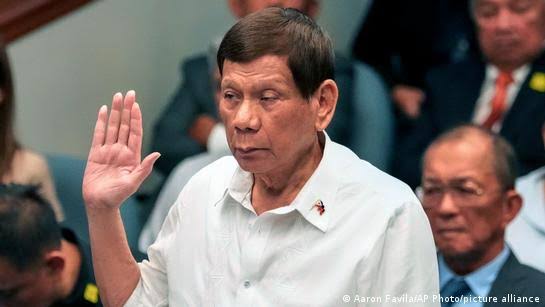
Former Philippine president Rodrigo Duterte has been ordered to stand trial at the International Criminal Court (ICC) on charges of crimes against humanity linked to his bloody anti-drug campaign, in a move hailed by rights advocates as a landmark for global justice.
Pre-trial judges at The Hague-based court unanimously confirmed charges of murder and attempted murder, finding “substantial grounds to believe” Duterte bears responsibility for a pattern of killings that prosecutors say formed part of a state-backed attack on civilians. He is accused in three counts of crimes against humanity, tied to at least 76 emblematic killings between 2013 and 2018, when he served first as mayor of Davao City and later as president.
Prosecutors allege Duterte helped create and direct a death squad in Davao that targeted suspected drug dealers and petty criminals, and that the same methods were later scaled up nationwide under his presidency. They argue that thousands were killed in police operations and vigilante-style attacks, often in poor communities, under a policy that encouraged lethal force.
During earlier confirmation hearings, ICC prosecutor Julian Nicholls told judges that Duterte had spent decades “murdering his own people” and that his public speeches, laced with threats to kill drug suspects, formed part of the evidence of an orchestrated campaign. Judges reviewed dozens of those speeches, in which Duterte vowed to “slaughter” criminals and promised bodies would “fill the rivers.”
The charges break down into alleged co-perpetration of 19 murders in Davao between 2013 and 2016, 14 killings of so-called high-value targets in the early phase of his presidency, and 43 deaths during nationwide “clearance” operations against low-level users and pushers. Rights groups and ICC investigators say these cases represent a fraction of a death toll that may run into the tens of thousands.
Duterte, now 81, has consistently denied ordering unlawful killings and insists his rhetoric was never intended as a command to murder. His lawyer Nicholas Kaufman argues there is “no smoking gun,” dismissing claims of a state policy to kill as “complete fiction” and attacking the credibility of prosecution witnesses.
The former leader’s defence team also contends he is too frail to participate meaningfully in proceedings, citing his confused and subdued appearance in a brief video link after his arrest. Nonetheless, the ICC has ruled that it has jurisdiction over the case, rejecting a challenge based on the Philippines’ withdrawal from the court.
Amnesty International Philippines called the decision to send Duterte to trial a “historic moment” that signals even powerful leaders may one day have to answer for systematic, deadly abuses.


.jpeg?alt=media&token=96b327a5-8e62-4ed1-a078-308aff149ed1)