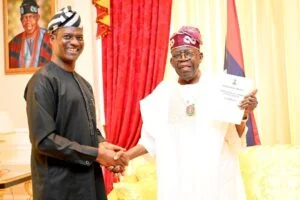
The Chairman of the Presidential Committee on Fiscal Policy and Tax Reforms, Mr. Taiwo Oyedele, has formally presented the Nigeria Tax Reform Acts to President Bola Ahmed Tinubu at the President’s residence in Lagos. The event, which drew the attention of key government officials and stakeholders in Nigeria’s fiscal sector, marks a significant milestone in the country’s ongoing efforts to overhaul its tax system and strengthen its fiscal framework.
Official photographs from the presentation show Mr. Oyedele handing over the comprehensive set of tax reform documents directly to President Tinubu. The occasion was attended by several high-ranking officials, including the Chief of Staff to the President, Femi Gbajabiamila; Chairman of the National Tax Policy Implementation Committee, Joseph Tegbe; and the Chairman of the Federal Inland Revenue Service (FIRS), Mr. Zacch Adedeji. Their presence underscored the importance the administration places on fiscal reforms and the collaborative approach adopted in shaping the new tax regime.
The Nigeria Tax Reform Acts are the culmination of months of rigorous work by the Presidential Committee on Fiscal Policy and Tax Reforms. The committee was established with a clear mandate: to review Nigeria’s complex tax laws, streamline the fiscal structure, and propose actionable reforms that would enhance revenue generation, reduce the multiplicity of taxes, and improve compliance across the board.
Earlier, President Tinubu had signed into law four critical tax reform bills, which form the backbone of the new fiscal framework. These include the Nigeria Tax Bill, the Nigeria Tax Administration Bill, the Nigeria Revenue Service (Establishment) Bill, and the Joint Revenue Board (Establishment) Bill. Each of these legislative instruments is designed to address specific challenges within Nigeria’s tax system, from administration and enforcement to harmonization and oversight.
The committee’s recommendations focus on harmonizing tax administration across federal, state, and local government levels, thereby reducing the burden of multiple taxation on individuals and businesses. The reforms also aim to simplify tax processes, making it easier for taxpayers to comply while empowering revenue authorities to enforce compliance more effectively. The National Tax Policy Implementation Committee and the Federal Inland Revenue Service have played pivotal roles in developing the implementation framework, working closely with other relevant institutions to ensure a smooth rollout of the new Acts.
With the formal presentation of the Nigeria Tax Reform Acts to President Tinubu, the stage is now set for nationwide implementation. The reforms are scheduled to take effect from January 1, 2026, aligning with the federal government’s fiscal calendar. This timeline provides government agencies, businesses, and the general public with a clear window to prepare for the changes and adapt to the new tax environment.
Stakeholders have welcomed the reforms, noting that a more efficient and transparent tax system is essential for Nigeria’s economic growth and development. By broadening the tax base, improving compliance, and reducing leakages, the government aims to boost revenue generation and create a more conducive environment for investment and business growth.
The presentation of the Nigeria Tax Reform Acts represents a significant step forward in the administration’s commitment to fiscal responsibility and economic transformation. As the country prepares for the implementation phase, all eyes will be on the government’s ability to deliver on the promise of a fairer, more efficient, and growth-oriented tax system.