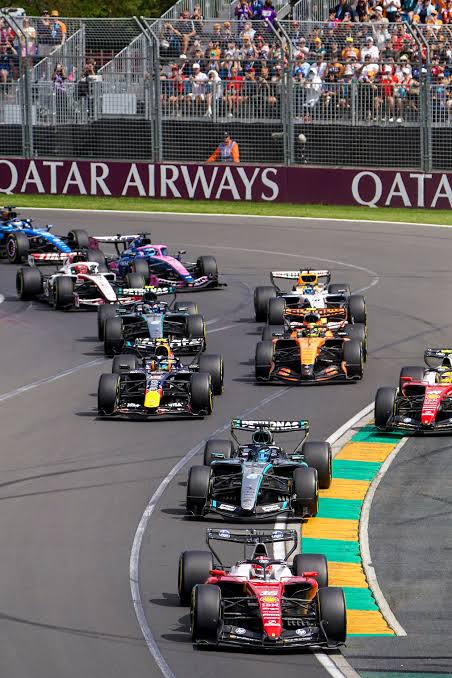
The opening race of Formula 1’s new regulations delivered exactly what the rule-makers promised: chaos, controversy and a kind of racing many in the paddock admitted they had never witnessed before.
Across 58 laps in Melbourne, there were 120 overtakes, with the headline act a breathless duel between George Russell and Charles Leclerc. The pair traded the lead seven times in nine laps, a sequence that left even hardened insiders stunned.
“Honestly, the first 10 laps of the race, I’m not sure that I saw something like this in the last 10 years,” Ferrari team principal Frederic Vasseur said. “It’s a very good start for the sport, a very good start for the show.”
Russell ultimately converted the spectacle into victory, leading a Mercedes one-two ahead of rookie team-mate Kimi Antonelli, with Leclerc third and Lewis Hamilton fourth. Yet the result was almost secondary to the debate raging over how that racing had been produced.
The 2026 power-unit rules have shifted the balance decisively toward electrical deployment. Drivers now juggle complex energy maps, with “Overtake Mode” allowing a chasing car within one second to unleash a higher speed tolerance over a lap. The effect in Melbourne was dramatic: cars rocketing past on the straights, only to be repassed a lap later as battery strategies flipped.
Some loved it. Hamilton, who never warmed to the previous ground-effect era, was effusive. “I personally loved it. The race was really fun to drive. The car was really, really fun to drive. I watched the cars ahead and there was good battling back and forth. It was awesome.”
Others were far less impressed. Reigning champion Lando Norris and Haas driver Esteban Ocon both branded the racing “artificial”, arguing that the ebb and flow owed more to software than to skill. “Depending on what the power unit decides to do and randomly does at times, you just get overtaken by five cars or you can just do nothing about it,” Norris said.
Max Verstappen, long a critic of the new formula, likened it to “Formula E on steroids” and renewed his warning that the heavy emphasis on lift-and-coast and battery management risks diluting what he considers “proper Formula 1 on steroids”.
Mercedes boss Toto Wolff struck a more measured tone, noting that in close combat “performances converge, which makes it exciting”, while cautioning that clear air still reveals the true pecking order.
Russell urged patience, pointing out that Melbourne’s multiple deployment zones exaggerated the effect. Shanghai’s single, vast back straight will offer a very different test. “Everyone’s very quick to criticise things,” he said. “We should just give it a chance and see after a few more races.”