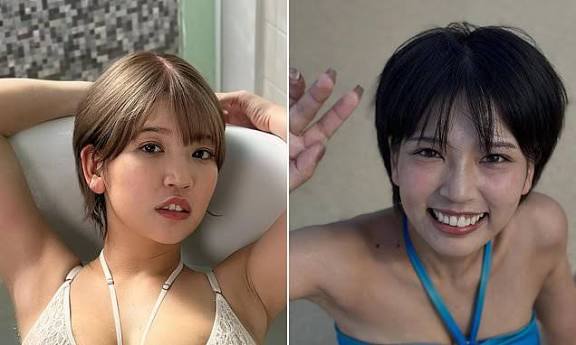
Japanese swimsuit model and gravure idol Aoi Fujino has d!ed at the age of 27, just days after she publicly announced her retirement and asked fans to remember her with a smile. Her passing has sent a wave of shock and grief through Japanese entertainment circles and among tens of thousands of followers who had watched her confront a rare cancer with candor, humor, and resilience.
Fujino, known for her work in provocative swimsuit and lingerie shoots as well as appearances in magazines and online platforms, had built a devoted fan base with her bright personality, playful image, and direct engagement with supporters. Behind the glamorous photos, however, she had been fighting a serious illness for several years.
Her final message to fans, posted online as she announced her retirement, now reads like a heartbreaking farewell. “This is my last message to all Aoi Fujino fans,” she wrote. “I really loved you. Thank you so much for everything up until now. Please remember me once in a while. Lol.” The lighthearted “Lol” at the end, characteristic of her tone even in difficult times, has taken on a poignant weight in the wake of her de@th.
Just days after that post, her mother announced that Aoi had passed away following a long battle with illness. The statement, shared through Fujino’s own social media account, expressed the family’s gratitude to those who had supported her throughout her career and treatment. “We would like to express our sincere gratitude to everyone who took care of her during her lifetime,” her mother wrote, addressing the fans, colleagues, and medical staff who had been part of Aoi’s journey.
Born in Ishikawa Prefecture, on Japan’s central Honshu coast, Aoi Fujino entered the entertainment world as a gravure model, a popular genre in Japan that focuses on swimsuit and lingerie photography, often blending pin-up style with a girl-next-door charm. She quickly distinguished herself with a combination of striking looks and an approachable, candid online presence. Fans followed not only her professional shoots but also her casual posts, behind-the-scenes glimpses, and personal reflections.
Her career trajectory changed dramatically when she was diagnosed with rhabdomyosarcoma, a rare and aggressive malignant tumor that develops in soft tissue, often affecting children and young adults. The diagnosis, made about three years before her de@th, forced her to step away from the spotlight and focus on treatment. Rhabdomyosarcoma is known for its difficulty to treat and its tendency to recur, and patients often endure intensive chemotherapy, radiation, and surgeries.
Fujino chose to share parts of this struggle with her followers, turning her social media into a space where glamour and vulnerability coexisted. She documented hospital visits, spoke about the physical and emotional toll of treatment, and at times reflected on fear and uncertainty. Yet she also continued to post cheerful photos, jokes, and messages of gratitude, determined to maintain the image of the “beautiful and energetic” self that she wanted people to remember.
After a period away from work, she made a tentative return to modeling in August 2024. The comeback was greeted with enthusiasm by fans who had been rooting for her recovery. She resumed photo shoots and public appearances, signaling that she was trying to reclaim a sense of normalcy and professional identity despite her illness. But the return proved short-lived. Within about six months, her health deteriorated again, and she was forced to step back once more.
Even then, Fujino did not completely disappear from public life. She continued to attend meet-and-greet events when her condition allowed, meeting fans face-to-face, signing merchandise, and posing for photos. Those who met her during this period often described her as warm, upbeat, and determined to make each encounter meaningful, even as she was visibly weakened by treatment.
Her Instagram account, which had grown to around 70,000 followers, became a kind of living archive of her dual existence as both idol and patient. In one of her final posts, she reflected on how she hoped to be remembered. “As long as people remember that beautiful and energetic me, I will be very happy and feel extremely blessed,” she wrote. The line encapsulated her desire to be seen not only as a victim of illness, but as the vibrant young woman she had been before cancer reshaped her life.
In Japan’s entertainment industry, where youth and physical perfection are often emphasized, Fujino’s openness about her illness stood out. While many performers choose to keep serious health issues private, she allowed fans to witness her vulnerability, without abandoning the playful persona that had made her famous.
Fans have flooded social media with messages of condolence, sharing favorite photos, clips from her shoots, and screenshots of her posts. Many have quoted her final messages, promising to “remember her once in a while” as she had asked. Others have written about how her courage in facing a rare cancer at such a young age inspired them to confront their own struggles with more strength.
Colleagues and photographers who worked with her have described her as professional, cheerful, and uncomplaining, even when she was clearly unwell. Some recalled that she would apologize for needing breaks during shoots, or joke about hospital gowns and IV lines as if they were just another costume. That determination to keep things light, they say, was not a denial of reality but a way of protecting both herself and those around her.
Rhabdomyosarcoma, the disease that claimed her life, remains relatively little-known outside medical circles, despite its severity. It arises from cells that normally develop into skeletal muscle and can appear in various parts of the body, including the head and neck, limbs, and genitourinary tract. Treatment often involves a combination of surgery, chemotherapy, and radiation, and outcomes depend heavily on the tumor’s location, size, and how early it is detected. Fujino’s case has drawn renewed attention in Japan to the challenges faced by young adults with rare cancers, who often fall between pediatric and standard adult care systems.
For many of her followers, however, Aoi Fujino will not be remembered primarily as a symbol of illness, but as the lively figure who smiled from magazine covers and social feeds, cracking jokes even as she confronted the possibility of a shortened life. Her final retirement message, framed as a casual goodbye, now reads as a deliberate act of closure: a young woman choosing her own words, her own tone, and her own way of saying farewell.
“I really loved you,” she told her fans. In the days since her passing, the outpouring of grief and remembrance suggests that the feeling was mutual. And as her followers continue to share her images and words, they are, in their own way, honoring the simple request she left behind: to be remembered, once in a while, as the beautiful and energetic Aoi she always tried to be.