ABU FACULTY OF SOCIAL SCIENCES HOSTS 3RD SYMPOSIUM
By:
Abubakar Basiru
abubakarteacher6569@gmail.com
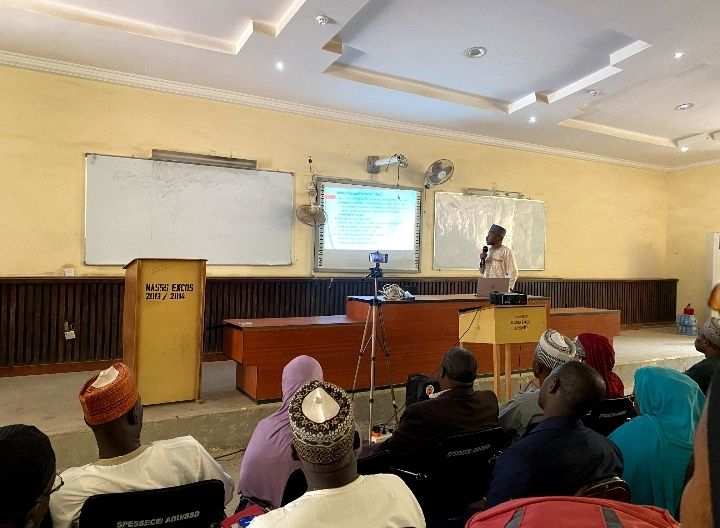
The Faculty of Social Sciences at Ahmadu Bello University held its 3rd Symposium on April 13, 2026, at Lecture Theatre II, Faculty of Social Sciences, Samaru campus, Zaria.
The symposium this time focused attention on the topic "Fiscal Deficit Biases and Time inconsistency in Monetary policy: Empirical Evidence From Nigeria".
The event attracted the attention of many and various stakeholders. In attendance were Professor Adamu Ahmed, Vice-Chancellor, Ahmadu Bello University, represented by Professor Raymond Bako, Deputy Vice-Chancellor (Academic); Dean of the Faculty of Social Sciences, Professor Shamsuddeen Mohammed; and Dr. Adama Adamu, Head of Department, Mass Communication, and Chairperson of the occasion.
Also present at the event were Director, Institute for Development Research and Training (IDR&T), Dr. Kabiru Salihu; Professor Maryam Aminu, Chairperson of the Committee of Deans and Directors; Professor Ibrahim Jimoh from the Department of Mass Communication; heads of departments, deans of faculties, teaching and non-teaching staff, and students among others.
In his remarks, Professor Shamsuddeen Mohammed, who is the host for the occasion, highlighted their commitments to government policies and issues affecting the daily lives of Nigerians.
"Faculty of Social Sciences has decided to revive this important intellectual tradition in order to enable members of the university community and the society at large to gain a clear understanding of some important public policies and other critical issues that affect our society", he said.
He further explained in an interview with The Trends that university is not only about attending classes and listening to lecturers but also about discussing issues that matter to the society.
"University is not all about classroom learning. There are many things you can learn particularly disciplinary issues through the symposium. So if you don't have this room, it's going to be difficult for students to understand the link between various social sciences disciplines", he stated.
He added, "Today, we are all aware about various socio-economic and political challenges that are affecting our society. So in the environment like that of university, there is need from time to time, we come together and discuss some issues so that we will be better informed about certain actions taken by government. You can particularly remember that the area of monetary policy and other economic issues are issues that are mostly understood by those in the discipline".
Delivering the keynote address, the Vice-Chancellor, Professor Adamu Ahmed, who was represented by Professor Raymond Bako, Deputy Vice-Chancellor (Academic), expressed his deepest appreciation and commended the efforts of the Faculty for maintaining the culture of intellectual discourse and shaping public understanding on issues affecting their lives.
As the chairperson of the occasion, Dr. Adama Adamu appreciated the invited guests and all attendees, describing the event as a moment to have clarification on things directly affecting all and sundry in Nigeria.
"Today is a day for us in the faculty to understand certain things that directly affect us, but which most of the time, we are not clear about them, especially as laymen, outside of the field of economics", she stated.
The chairperson also urged the presenter to explain every point in a clear and understanding manner. "I hope the presenter will be able to put it in a way that the layman will understand", she mentioned.
Dr. Usman Adamu Bello, the paper presenter, presented his in-depth findings on the subject matter. He begins by situating the paper within the current Nigerian economic reality, describing it as “less than impressive” and focusing on two key macroeconomic indicators: inflation and jobless growth. Inflation is highlighted as “the most important indicator that shows the manifestation of time inconsistency.”
The presenter notes that since 2015, food inflation has risen significantly, “to about 41% in 2024,” before slowing to “19%, mostly driven by food imports.”
Non-food inflation is also examined, increasing from “8% as of 2015” to “almost 22%.” This is emphasized as more impactful on citizens because “that is what affects us the most… the money we have in our pockets… the wages we earn… and the well-being or the cost of living.”
Dr. Usman Adamu Bello successfully presented his paper on various important issues related to the subject matter.
Following the presentation, Dr. Kabiru Salihu, Director, Institute for Development Research and Training (IDR&T), and Dr. Soliu Hamzat from the Department of Economics, who served as the discussants of the paper, broke down the presentation into its most comprehensive form and added valuable insights. Inputs and questions were later entertained from participants.
The event concluded with a vote of thanks delivered by Dr. Shuaibu Mohammed, a member of the symposium committee. Speaking on behalf of the Faculty of Social Sciences symposium committee of Ahmadu Bello University, he expressed deep appreciation to the invited guests, participants, students, staff, and the organizing team for their contributions to the successful hosting of the symposium.