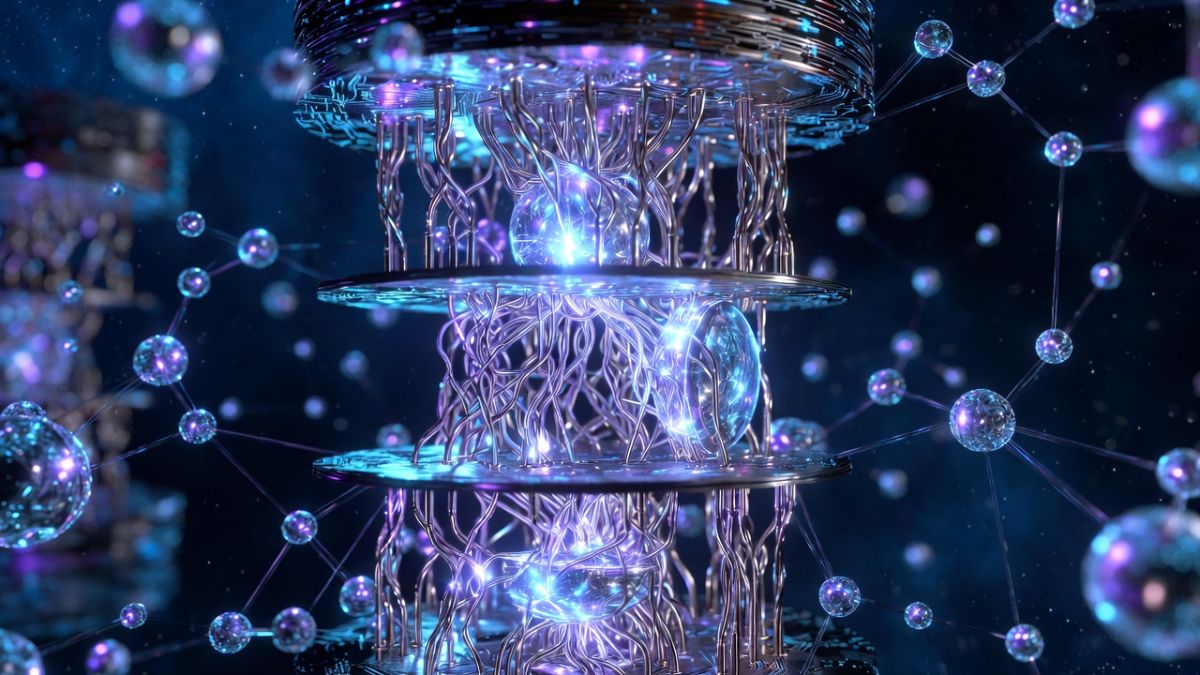
Imagine a computer so powerful it could solve problems in seconds that would take today’s fastest machines thousands of years. This is the promise of quantum computing, one of the most revolutionary and exciting fields in modern science and technology.
Traditional computers process information using bits, which can exist in only two states: 0 or 1. Everything we use today—from social media apps to banking systems—relies on this binary system. While highly effective, traditional computers have limits when tackling extremely complex problems.
Quantum computers operate differently. Instead of regular bits, they use quantum bits, or qubits, which can exist in multiple states simultaneously through a phenomenon called superposition. This allows quantum computers to perform many calculations at once, rather than sequentially, giving them enormous processing power.
Another remarkable feature is quantum entanglement, where two particles become linked so that the state of one instantly affects the other, even across large distances. Scientists leverage this property to build computing systems capable of handling vast amounts of information far more efficiently than classical computers.
The applications of quantum computing are staggering. In medicine, it could analyze complex molecular structures and accelerate the discovery of new drugs and treatments for diseases. In climate science, quantum computers could help build more precise models to predict climate change and develop strategies for environmental challenges.
Quantum computing also has major implications for cybersecurity. While it could enable stronger encryption methods, it also has the power to break many existing security systems. This makes developing quantum-safe encryption technologies a priority for researchers worldwide.
Despite its potential, quantum computing is still in its early stages. Qubits are extremely sensitive to environmental factors like temperature fluctuations and electromagnetic interference, making stable quantum computers difficult to build. Scientists across the globe are working tirelessly to overcome these technical hurdles.
Major technology companies and research institutions are investing heavily, believing that quantum computing could be the next major breakthrough of the 21st century.
CONCLUSION:
Quantum computing represents a bold new frontier in science and technology. Though still emerging, its ability to revolutionize healthcare, cybersecurity, and environmental research makes it one of the most fascinating innovations of our time. The quantum era is on the horizon, and it promises to transform the way humanity solves its most complex challenges.