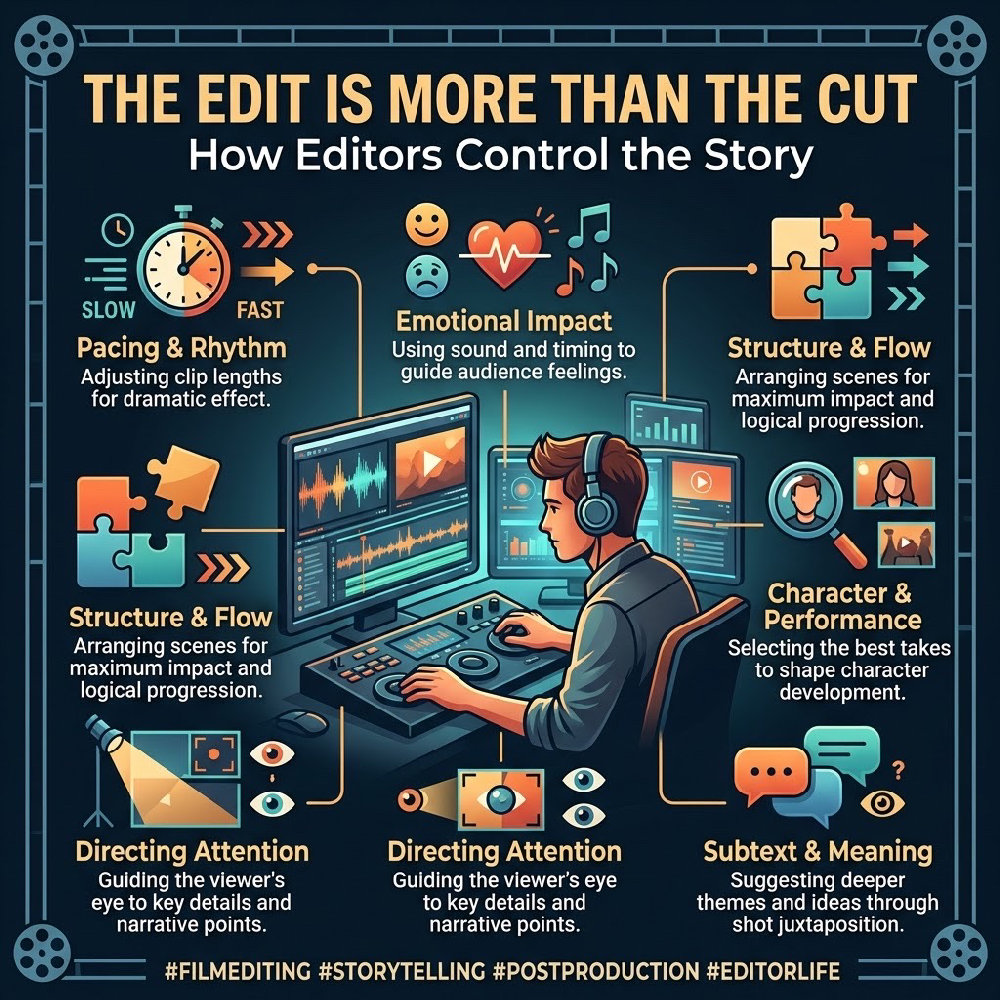
I think one of the biggest misconceptions about editing is that it’s simply about putting clips together.You shoot the footage, import it into your timeline, arrange the clips, add some music, clean things up, and export.But editing is much more than that.Editing is about controlling information.It’s about deciding what the audience sees.What they don’t see.What they know.What they don’t know yet.And, most importantly, what they feel.
The Same Footage Can Tell Different Stories
Imagine giving two editors the exact same footage.Same actors.Same camera angles.Same dialogue.Same location.Same everything.Yet, they could produce two completely different scenes.One editor might make the scene feel tense.Another might make it feel funny.Another might make it emotional.The footage didn’t change.The decisions did.One editor might hold a shot for two extra seconds, making the audience uncomfortable.Another might cut immediately, creating energy.One might reveal information early.Another might deliberately hide it until later.One might use silence.Another might fill the moment with music and sound design.These choices completely change the audience’s experience.
Editing Is About Information
Every cut gives the audience information—or takes information away.Think about a simple conversation.If I show you someone’s reaction before you hear what was said, you experience the conversation differently than if I reveal the reaction afterward.If I show you what’s behind a character before they notice it, you might become anxious.If I hide it from you, you experience the scene through the character’s perspective.The footage is still the same.But the order, timing, and selection of information have changed.That’s the power of editing.
What Should the Audience Know?
A good editor is constantly asking questions.What should the audience know right now?What should they discover later?What should they expect?What should surprise them?What should remain hidden?These questions are especially important when building suspense.Sometimes, showing less creates more tension.You don’t always need to show the threat.Sometimes, the audience imagining what might be there is more powerful than seeing it.The editor controls that experience.
Storytelling With Time
This is why I’m starting to think of editing less as “cutting clips” and more as storytelling with time.A writer controls words.A cinematographer controls what the camera sees.A director controls performances and decisions on set.An editor controls how all of those pieces are experienced over time.A few frames can change the meaning of a moment.A longer pause can make a character seem uncertain.A faster sequence can create urgency.A delayed reveal can create suspense.A cut to a reaction can completely change how we interpret what was just said.That’s storytelling.And it happens inside the timeline.
Every Cut Is a Decision
The more I edit, the more I realize that there is rarely a completely neutral cut.Every decision communicates something.Cut here.Don’t cut yet.Show this.Hide that.Let the silence continue.Bring the music in now.Hold the reaction.Each decision affects what the audience experiences.That’s why two editors can take the same footage and tell completely different stories.The editor isn’t simply assembling footage.The editor is shaping the audience’s journey through the story.And that’s what makes editing so fascinating to me.It’s not just about making clips fit together.It’s about deciding what the audience experiences, when they experience it, and how they feel when they do.That’s editing.That’s storytelling with time.