South Africa has formally returned ancestral human remains and a revered national artefact to Zimbabwe, in a solemn ceremony that underscored growing global momentum for the restitution of items seized under colonial rule.
The handover took place at a museum in Cape Town, where eight small coffins, each draped in the Zimbabwean flag, were arranged in a quiet semicircle. The remains, removed from what are believed to have been graves more than a century ago, were taken to South Africa as “scientific specimens” during the height of colonial expansion in southern Africa.
Researchers and officials say the remains include those of a traditional leader whose skull and jaw were collected in 1910, as well as a man reportedly killed after accusations of witchcraft. None of the individuals, nor their families, gave consent for their bodies to be exhumed or transported, a fact repeatedly acknowledged during the ceremony.
South Africa’s Minister of Sports, Arts and Culture, Gayton McKenzie, framed the restitution as both a moral and political imperative. He said South Africa could not credibly demand the return of African heritage from Europe and elsewhere while holding on to items taken from neighbouring countries. He described the move as part of an effort by the government of national unity to act as an “ethical state” and to correct historic wrongs.
Zimbabwean officials characterised the return as an act of remembrance and repair. Reverend Paul Bayethe Damasane, Deputy Chief Secretary to the President and Cabinet, said the ceremony helped “remember what was dismembered,” calling the repatriation an identity marker for Zimbabweans and a sign of solidarity between Harare and Pretoria.
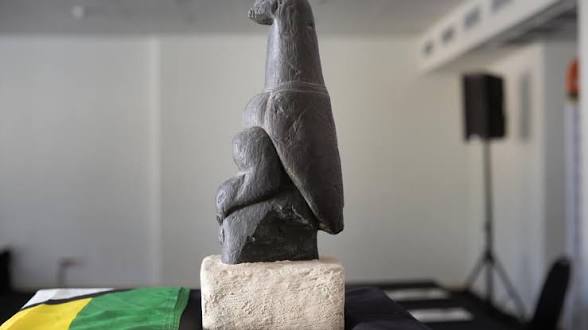
Alongside the human remains, South Africa also handed back a centuries-old soapstone carving of the Zimbabwe bird, a stylised eagle-like figure that is one of the most potent symbols of Zimbabwean nationhood. The carving was taken from the ruins of Great Zimbabwe in the late nineteenth century by a British explorer and later acquired by colonial magnate Cecil John Rhodes.
The Zimbabwe bird, whose original sculptures date from the era when Great Zimbabwe was a thriving regional power, appears today on Zimbabwe’s flag, currency and official insignia. Its return is seen by cultural historians as a powerful restoration of spiritual and historical continuity.
Once back in Zimbabwe, the remains are expected to be reburied with full traditional rites, closing a painful chapter that has stretched across generations and reinforcing calls for wider restitution of African heritage worldwide.