At the quiet corner of my childhood neighborhood stood a house that defied time,a house so peculiar, so deeply rooted in its own history, that it felt like a secret the modern world had forgotten. We called it The Old Kebang's house, but it was more than old. It was sacred. It was strange. And it was beautiful in a way only those who looked closely could understand.
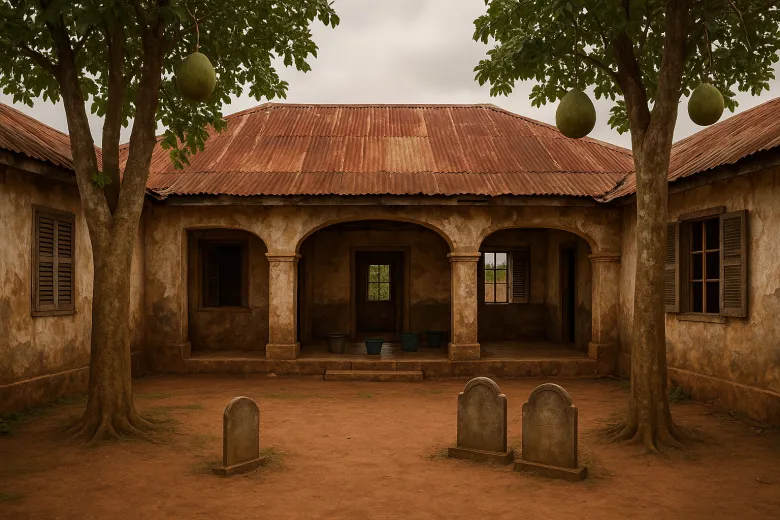
It sat at the edge of the street like a stubborn elder who refused to change her ways. The compound held not mango trees or flamboyant like the others did, but calabash trees,those thick-trunked, wise-looking ones whose fruit once carved out bowls, instruments, and stories from generations past. Even the trees whispered of another time.
The house itself had a wide, cavernous parlor that echoed like a chapel, and a courtyard that opened up to the sky like an old soul lifting its face to heaven. Its architecture was odd to some, maybe even confusing but if you stared long enough, you could almost see the vision the architect had in mind. It was a dream. A masterpiece ahead of its time.
But not everyone sees beauty in the unfamiliar.
When I was ten, I wandered into the compound, curious and wide-eyed until I saw the grave. Just one, quietly resting by the side. I later found out it belonged to the couple who built the house, now resting where their dreams were laid in stone.
They had children James, Jonah, and Katrina. All of them bright, promising souls. People once whispered how they were going to take over, turn the house into something greater than their parents even imagined. But promise has a way of fading when the heart is swayed.
Jonah and Katrina died young lost to the chaos of a world that pulled them into drinking, smoking, and empty pleasures. James remains, but barely. A man wandering through life, collecting the ruins of a legacy he was meant to carry. Still drinking. Still smoking. Still watching the house crumble under his watch, unable or unwilling to rebuild what his parents left behind.
One rainy afternoon, I went to visit my friend Josephine, who lived in a part of the house. As I stepped inside, I was greeted not just by the heavy scent of moisture, but by the scattered buckets placed strategically across the parlor to catch the relentless drops from the ceiling.
Josephine sighed, pushing aside a bucket with her foot.
"Anytime it rains, I just feel so dismayed," she said with a tired laugh. “After every rain, I have to work extra,mop everywhere. Some places, even if you put a bucket, it doesn’t help. The water still finds its way. It's like this house has holes in its bones.”
And yet, the house remains.
And I think about it often how, if I had the money, I would buy that house. Not to erase its past, but to celebrate it. I’d preserve the courtyard, polish the calabash trees, rebuild every wall with a touch of modern beauty but the soul of its original vision intact. It would become a life-giving space,a place that brings back the nostalgia of “then,” wrapped in the freshness of “now.” A place that reminds us of what we can do when we honor what came before us.
Because somewhere, in our generation, are children who can revive old dreams. Who can take a so-called “weird” house and turn it into something unforgettable. Something worth keeping. Something worth passing on.
We just need the courage to see beauty where others see strange and the will to build not just for ourselves, but for the legacy that brought us here.