Rory McIlroy’s journey to the Green Jacket was never going to be straightforward. For more than a decade he had carried the weight of expectation, the near-misses and the scars of Augusta, most notably his back-nine collapse in 2011. When he finally completed the career Grand Slam, it came in a fashion that felt perfectly, agonisingly McIlroy.
His week began inauspiciously. Backed publicly by legends Jack Nicklaus and Gary Player, McIlroy stumbled to an opening 72, wrecked by three double bogeys over his final four holes. He trailed by seven, needing to match the greatest comebacks in Masters history simply to rejoin the conversation.
Friday changed everything. A sparkling 66 vaulted him into contention and reminded the patrons why his game had long been considered tailor-made for Augusta. On Saturday he produced another 66, opening with six consecutive threes to make history and seize a two-shot lead. It was his first 54-hole advantage at the Masters since 2011, and the ghosts of that Sunday hovered over every swing.
The final round was a study in volatility. A double bogey at the first wiped out his cushion immediately. Bryson DeChambeau briefly surged ahead before faltering, while McIlroy mixed brilliance with brinkmanship: threading recovery shots through trees, laughing in disbelief at escapes that defied geometry, and riding the roars that ricocheted through the pines.
He seemed to seize control with birdies at nine, ten and a nerveless par save at 11, only to hand the tournament back at the 13th, where a wedge from lay-up distance spun cruelly into Rae’s Creek for yet another double bogey. A bogey at 14 left him trailing Justin Rose with four to play.
Then came the shot that will live in Masters lore. At the par-five 15th, McIlroy carved a seven-iron around the trees, the ball bending impossibly to finish inside ten feet. The birdie there, followed by another at 17, sent him to the 72nd tee with a one-shot lead.
He found the fairway but pushed his wedge into sand and failed to save par. The missed five-footer for victory summoned memories of other majors that slipped away. Yet in the playoff he reset, striped another perfect drive at 18 and stiffed his wedge to four feet. Rose missed. McIlroy did not.
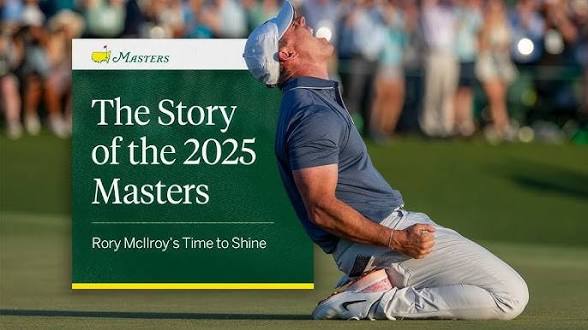
As the putt dropped and he sank to his knees, the narrative shifted. No longer the nearly man, he joined Nicklaus, Player, Hogan, Sarazen and Woods as a member of golf’s most exclusive club: a Masters champion and a career Grand Slam winner, at last at peace with Augusta National.