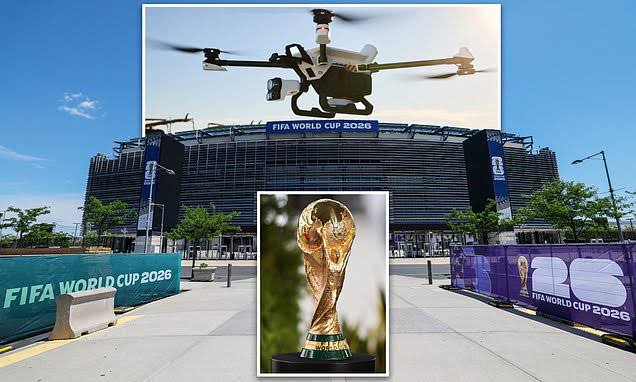
World Cup organizers are preparing to deploy life-saving medical drones across stadiums in the United States, Canada, and Mexico, in a major upgrade to fan safety for the 2026 tournament.
The so-called Guardian drones, supplied as part of Motorola Solutions’ wider security operation, will be equipped with defibrillators, epipens, first aid kits, and radios. Each device can carry a payload of around 10lb, allowing it to deliver critical medical equipment directly to the scene of an emergency inside vast, crowded arenas where every second counts.
In practice, the drones will be dispatched to precise locations in the stands or concourses when a medical alert is raised. Once on site, the onboard radio will connect nearby fans or stewards with specially trained medics, who can talk them through the use of an automated external defibrillator or epipen until professional responders arrive.
Emergency medicine specialists say this kind of rapid-response system can significantly improve survival rates in cases of sudden cardiac arrest or severe allergic reaction, where outcomes are closely tied to how quickly treatment begins. With stadium capacities set to exceed 70,000 at many venues, traditional response teams can face delays navigating dense crowds and complex layouts.
The aerial safety net is part of a broader technological shield around World Cup venues. Motorola is partnering with drone-detection firm SkySafe to monitor and control the airspace above stadiums and training grounds, aiming to prevent unauthorized drones from entering restricted zones.
According to security planners, the system can identify and track rogue drones, then deploy a range of countermeasures. These include signal jamming to sever the link between a drone and its pilot, GPS spoofing to mislead an aircraft about its true location and steer it away, and the use of interceptor drones equipped with lightweight nets to capture and disable hostile devices.
Officials stress that any kinetic or jamming measures will be carefully managed to avoid risks to spectators, with protocols tailored to whether stadiums are full or empty. Together, the life-saving Guardian drones and the defensive systems around them are intended to make the 2026 World Cup one of the most technologically advanced and tightly protected tournaments ever staged.