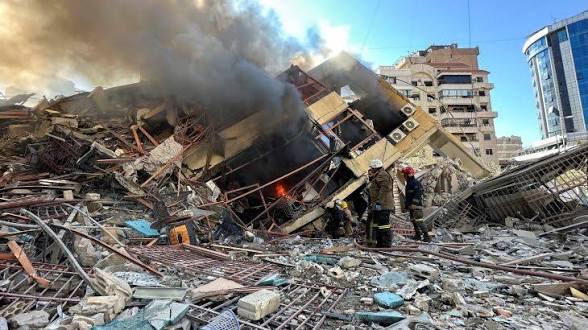
The United Nations’ top humanitarian official has warned that the war engulfing parts of the Middle East is draining an estimated $1 billion every day, even as life-saving aid operations around the world are starved of funds and needs surge to record levels.
Under-Secretary-General for Humanitarian Affairs Tom Fletcher said the financial scale of the conflict stands in stark contrast to the UN’s struggle to raise money for civilians on the brink of famine, disease and displacement from Africa to the Middle East and the Caribbean.
Speaking in Geneva, Fletcher said a $23 billion global appeal to support 87 million of the world’s most vulnerable people remains roughly two-thirds unfunded, leaving a gap of more than $14 billion. That shortfall, he stressed, is emerging just as the cost of the Middle East war soars.
“Even just one billion US dollars would allow us to save millions of lives,” he said, framing the situation as a stark moral and political choice for governments and major donors. “Without additional support, millions of people will die.”
The appeal underpins what the UN calls a “hyper-prioritized plan,” targeting those in greatest need through some 2,000 humanitarian organizations, 60 percent of them local partners. In January alone, the plan enabled aid workers to reach more than seven million people in the hardest-to-access areas across 17 operations, including Haiti, the Democratic Republic of the Congo and Sudan.
In Sudan, where conflict and displacement have devastated communities, nearly two million people received assistance in a single month despite severe security and logistical constraints. Fletcher urged donors to frontload their contributions so that similar levels of support can be sustained throughout the year.
He also voiced alarm over the broader economic shockwaves from the fighting, particularly the near-standstill of shipping through the Strait of Hormuz, a vital chokepoint for global oil supplies. Disruptions there, he warned, risk driving up food, fuel and fertilizer prices worldwide, with direct consequences for already fragile humanitarian supply chains, especially in sub-Saharan Africa.
Fletcher condemned the rapid expansion and deployment of drones and other advanced weaponry in the conflict as evidence that the world is “far more interested” in funding tools of war than in financing efforts to save lives. To date, the UN’s global appeal has attracted only a fraction of what is needed from foundations, corporations and individuals, underscoring, he said, that “we cannot rely on governments alone.”