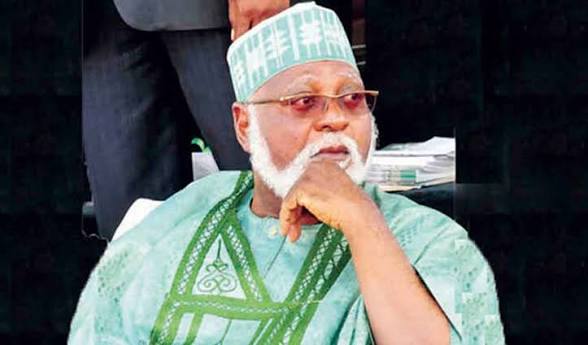
Former Head of State General Abdulsalami Abubakar has disclosed that a powerful clique of senior officers around General Sani Abacha once marked him and three other top commanders for removal from the regime, and possibly worse.
Abubakar makes the revelation in his autobiography Call of Duty, launched in Abuja alongside two other books, Nigeria’s Grand Patriot and Mediating for Peace in Africa. The event drew a high-powered audience, including President Bola Tinubu’s representative, Vice President Kashim Shettima, former Head of State General Yakubu Gowon, and former presidents Olusegun Obasanjo and Goodluck Jonathan.
In the book, Abubakar describes a tight inner circle he calls “caucus members” who operated as Abacha’s kitchen cabinet, exerting outsized influence on key decisions. According to him, this group repeatedly pushed for the retirement of four senior officers: Lieutenant General Jeremiah Useni, Lieutenant General Garba Duba, Major General Mohammed Balarabe Haladu and Abubakar himself.
He writes that Abacha’s personal loyalty to old friends repeatedly saved them. “All the time, four of us who were slated for retirement survived because Abacha was devoted to friendship,” Abubakar recalls, noting the irony that the so-called “hawks” were eventually retired before their intended targets after becoming “a pain in Abacha’s neck.”
Abubakar, who served as Chief of Defence Staff under Abacha, says he confronted the ruler directly about the clique. In private conversations, he addressed Abacha simply as “Sani” while Abacha called him “Mallam.” During one such exchange, Abubakar urged him to dismantle the group, warning that they were a bad influence on his government. Abacha initially asked Abubakar to caution them, but he refused, insisting the Head of State had to act personally. “Finally, one by one, he retired them from the military,” Abubakar writes.
He also sheds light on internal debates within the Provisional Ruling Council, insisting that contrary to public perception, the council did meet, though many decisions were pre-cooked by the kitchen cabinet. Abubakar says some members pressed Abacha to release Chief MKO Abiola and open direct talks with him over the June 12 crisis, but the advice was ignored.
On allegations of massive looting by Abacha, Abubakar portrays a more complex picture, describing him as frugal and strict with official funds, while admitting he later saw documents linking large foreign transfers to Abacha’s family and associates. He suggests Abacha may have been advised to move funds abroad as a hedge against international sanctions, but concedes he was never taken into confidence on those transactions.