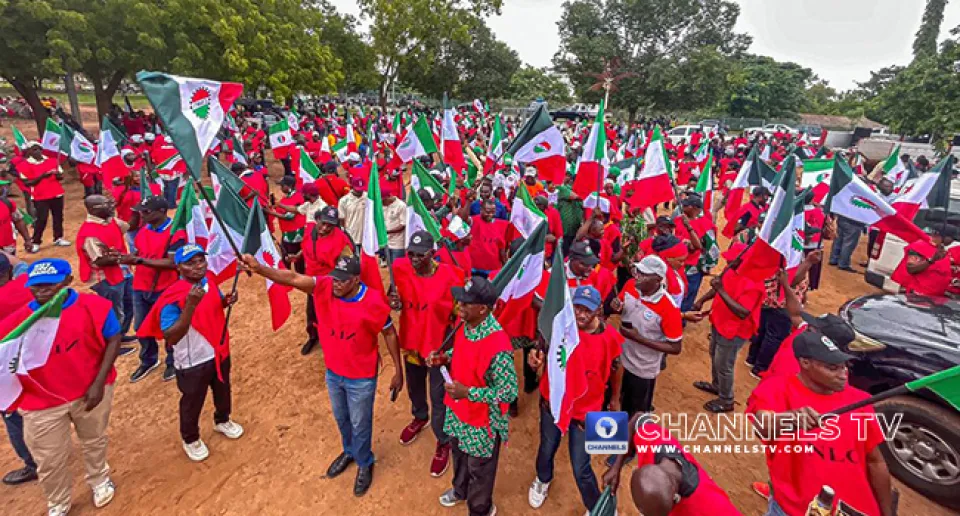
The Organised Labour has reiterated that the one-week grace period granted to the Federal Government, which began on Tuesday, June 4, 2024, will end at midnight on Tuesday, June 11, 2024. This ultimatum follows the ongoing deadlock in negotiations over a new minimum wage for Nigerian workers.
Chris Onyeka, an Assistant General Secretary of the Nigeria Labour Congress (NLC), emphasized on Channels Television’s The Morning Brief show that if the Federal Government and the National Assembly fail to meet the workers' demands by the deadline, the NLC and the Trade Union Congress (TUC) will reconvene to decide whether to resume the nationwide strike that was paused last week.
Onyeka stated, “The Federal Government and the National Assembly have the call now. It is not our call. Our demand is there for them to look at and send an Executive Bill to the National Assembly, and for the National Assembly to look at what we have demanded, the various facts of the law, and then come up with a National Minimum Act that meets our demands."
He added, “If that does not meet our demand, we have given the Federal Government a one-week notice to look at the issues and that one week expires tomorrow. If after tomorrow, we have not seen any tangible response from the government, the organs of the Organised Labour will meet to decide on what next.”
When questioned about the labour's reaction if the government insists on ₦62,000 as the new minimum wage, Onyeka clarified, “We said we are relaxing a nationwide indefinite strike. It’s like putting a pause on it. So, if you put a pause on something and the organs that govern us as trade unions decide that we should remove that pause, it means that we go back to what was in existence before.”
He further dismissed any consideration of a ₦62,000 or even a ₦100,000 minimum wage, labeling such amounts as “starvation wage.” Labour’s latest demand stands at ₦250,000, which they regard as a living wage sufficient for the average Nigerian worker.
After numerous unsuccessful negotiations on a new minimum wage, Labour declared an indefinite strike on June 3, 2024, leading to the shutdown of essential services across the country. The current minimum wage of ₦30,000, established in 2019, is considered inadequate in light of soaring inflation and the economic impact of recent government policies, including fuel subsidy removal and forex unification.
The tripartite committee, inaugurated by President Bola Tinubu in January 2024, initially saw Labour demanding ₦615,000 as the new minimum wage, later reducing their demand to ₦494,000, and eventually to ₦250,000. The government, on the other hand, offered ₦48,000, ₦54,000, ₦57,000, and eventually ₦60,000, all of which Labour rejected.
Following intense negotiations and the strike's economic consequences, the government side of the tripartite committee committed to a wage above ₦60,000. This prompted Labour to suspend their strike on June 4, 2024, allowing time for further talks.
Despite this concession, the recent negotiations on June 7, 2024, failed to yield a consensus. Labour reduced their demand to ₦250,000, while the government slightly increased its offer to ₦62,000. Reports from both sides were submitted to President Tinubu, who is expected to send an executive bill to the National Assembly for a new minimum wage law.
The next steps depend on the government's response by the Tuesday deadline, with potential ramifications for the nation's industrial peace and economic stability.
Source: Channelstv