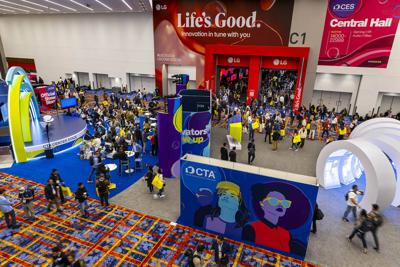
Las Vegas has once again turned into the tech industry’s favorite echo chamber, and this year’s CES 2026 is exactly what you would expect: AI slapped on everything that moves, blinks, or beeps. From chips to cars to construction gear to family calendars, the message is loud and clear: if it does not say “AI,” it might as well not exist.
Front and center, Nvidia’s Jensen Huang strutted onstage in his now-iconic leather jacket, delivering what looked less like a keynote and more like a coronation. His pitch was simple: Nvidia is the backbone of the AI world, and everyone else is just renting space. The company’s new Rubin architecture was hyped as the next big leap after Blackwell, supposedly ready to power even bigger, more complex AI models in real time across data centers, cars, and robots. Translation: Nvidia wants to own every serious AI workload on the planet.
Nvidia did not stop at chips. The company aggressively pushed its Alpamayo open source AI models and tools as the default brain for robots and smart machines. The comparison to Android was not subtle. From factory floors to delivery bots, Nvidia is openly gunning to become the operating system of the physical world, turning automation into yet another Nvidia-dominated domain.
Not to be outshone, AMD tried to flip the script by insisting that AI should not be trapped in the cloud. CEO Lisa Su brought out a parade of high-profile partners, including OpenAI’s Greg Brockman and AI heavyweight Fei-Fei Li, to sell a vision where your personal computer suddenly becomes “intelligent” enough to matter again.
The big play from AMD is the Ryzen AI 400 Series, chips that cram dedicated AI accelerators into laptops and desktops. The company framed this as the dawn of the “AI PC,” warning that any computer that cannot run AI models locally is basically obsolete. It is a bold line in the sand: either your next PC is “AI-ready,” or you are officially behind the times.
Beyond the chip war, the show floor is packed with products desperately trying to prove they are part of the AI moment, with results that range from genuinely impactful to borderline absurd.
In the car world, Ford teased an AI assistant that will first live in its mobile app and then slowly creep into vehicles around 2027. Hosted on Google Cloud and powered by generic large language models, it is supposed to help with routes, settings, and maybe even maintenance and charging. But Ford stayed vague on how smart or personal this assistant will really be, leaving plenty of room for skepticism about whether this is a true game-changer or just another talking dashboard.
Meanwhile, heavy industry is quietly getting a high-tech makeover. Caterpillar teamed up with Nvidia to show off Cat AI Assistant on an excavator, promising help with planning, safety checks, and real-time guidance. On top of that, Caterpillar is using Nvidia’s Omniverse to simulate construction projects before they start, using digital twins to cut down on mistakes. It is a stark reminder that some of the most serious AI action is happening far from shiny gadgets, in mines, ports, and construction sites that never make the sizzle reels.
On the consumer front, nostalgia is back in force. Clicks Technology rolled out the Communicator, a $499 smartphone that drags the physical keyboard back from the grave. It leans hard into BlackBerry-era sentimentality, with a contoured back for grip and a raised screen that protects the keys when the phone is face down. For those not ready to ditch their current phones, Clicks is also pushing a $79 slide-out keyboard accessory, betting that there is still a crowd that misses the click of real keys in a world of glass and autocorrect.
In a more grounded corner of the show, a family planning and organization tool is getting attention for using AI in a way that actually sounds useful. Instead of just being another shared calendar, it pulls in schedules from multiple services, scans messages and photos to build to-do lists, and fires off smart reminders. It is AI as a quiet background operator, not a flashy chatbot, aimed at managing the chaos of everyday family life rather than impressing onstage.
Robots are everywhere, and Hyundai is making sure no one forgets it. Teaming up with Boston Dynamics, the company showcased a new phase of humanoid and industrial robots, backed by Google’s AI research. Existing Atlas robots and a new humanoid model are being trained to move and think more like adaptable workers than choreographed performers. The implication is clear: the long-promised robot workforce is inching closer to reality, and the big players want to own that narrative.
Amazon, predictably, refused to sit this one out. The company used CES to push Alexa+ as its big generative AI reboot. A browser-based chatbot and revamped app are supposed to turn Alexa into a more conversational, context-aware assistant that follows you across devices. Tied into Fire TV and a new Artline TV lineup, Alexa+ is being positioned as the glue for content discovery and smart home control, even as Amazon scrambles to prove Alexa is still relevant in the age of chatbots.
Then there is Razer, once again treating CES as its personal sci-fi playground. This year’s spectacle is all about AI companions. Project Motoko promises the benefits of smart glasses without the actual glasses, hinting at some kind of wearable or ambient interface that feeds you information more discreetly. But the real head-turner is Project AVA, a digital avatar that literally sits on your desk as an AI companion. Instead of a voice in a speaker, AVA is a constant visual presence, blurring the line between assistant and digital pet. Whether it ever ships is anyone’s guess, but it perfectly captures the industry’s obsession with turning AI into something you “live with” rather than just use.