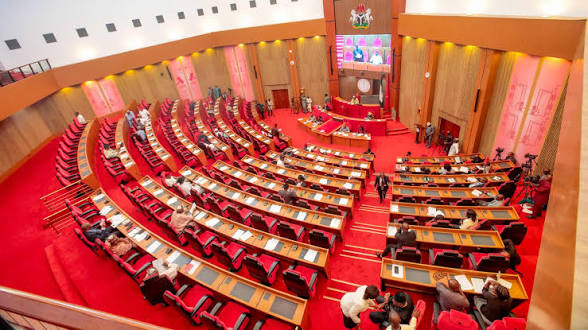
The Nigerian Senate has asked the Federal Government to halt the ongoing policy of pardoning, rehabilitating and reintegrating repentant Boko Haram members and other violent offenders, insisting the initiative has failed to stem the country’s deepening insecurity.
The resolution followed a motion by the Chairman of the Senate Committee on Army, Senator Abdulaziz Yar’Adua, who drew attention to a surge in targeted attacks, abductions and killings of serving and retired military personnel. Lawmakers cited the murder of former Director of Defence Information, retired Major General Rabe Abubakar, as emblematic of a worsening security climate.
During a heated plenary, senators condemned the deradicalisation and rehabilitation programmes that have seen thousands of former insurgents, bandits and kidnappers released back into communities. Several lawmakers argued that the policy has emboldened criminal networks, particularly in the North, by signalling leniency rather than deterrence.
They also highlighted a disturbing pattern of attacks on senior officers who once held sensitive intelligence and command roles. Among the cases raised were the killing of retired Major General Richard Duru in Owerri after a ransom was reportedly paid, the murder of retired Brigadier General O. M. Harlord Udokwere in Abuja, the 56-day abduction of former NYSC Director-General, retired Brigadier General Maharazu Tsiga, and the death in captivity of retired Major Aja in Kogi State. The Senate observed a minute of silence for Abubakar and other victims of terrorism, banditry and kidnapping.
Lawmakers urged the Federal Government to ensure the arrest and prosecution of perpetrators, and called on security and intelligence agencies to upgrade intelligence gathering, surveillance and early warning systems. They further pressed for rapid deployment of modern security technologies to confront armed groups.
The debate has thrown fresh scrutiny on Operation Safe Corridor, launched in 2016 to deradicalise and reintegrate former Boko Haram fighters who surrender. Thousands have passed through the programme, which officials long touted as a key pillar of counter-insurgency strategy.
Security analyst Babayo Sule, an Associate Professor at the University of Namibia, criticised the Senate’s stance as misguided. He argued that disarmament, deradicalisation and rehabilitation are globally recognised tools in resolving protracted conflicts and should be reformed, not scrapped. Sule said research has found no evidence that the programme itself fuels insecurity, blaming instead politicisation, corruption, obsolete equipment and institutional negligence.
He warned that abandoning rehabilitation without a credible alternative could close one of the few non-military pathways to peace and risk driving more fighters back into the ranks of extremist groups.