The Silence Between the Drums
When the old man died, nobody noticed the silence.
People cried. Women sang funeral hymns. Children ran around the compound. A Bluetooth speaker blasted traditional music into the village square.
Only Nkem noticed what was missing.
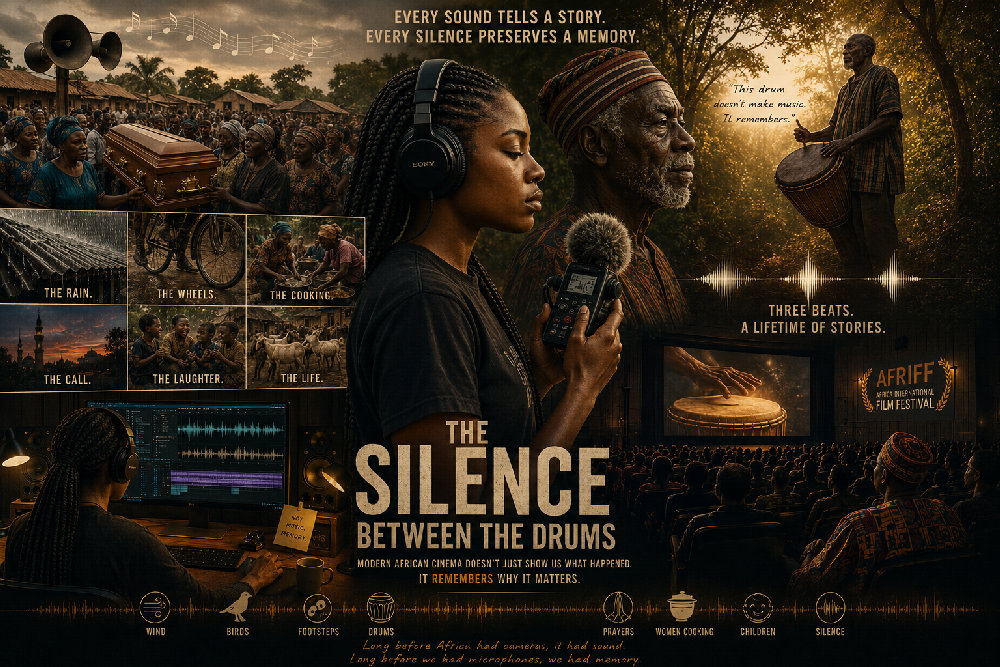
She was the sound designer on a documentary called The Last Drummer, a film about Pa Okorie, one of the last men in his community who could “speak” through the ikoro drum.
Before his death, he had once smiled at her and said, “This drum doesn’t make music. It remembers.”
At the time, Nkem thought he was simply being poetic.
In film school, everyone dreamed about expensive cameras and beautiful shots.
Nobody talked about sound.
“You can forgive a blurry picture,” Nkem once argued during class, “but you cannot forgive a story that has nothing to say.”
Her classmates laughed.
She didn’t.
While filming the documentary, Nkem recorded more than interviews.
She recorded rain hitting zinc roofs.
The squeak of bicycle wheels.
The hiss of akara frying beside the road.
The call to prayer drifting across the evening sky.
Children laughing.
Goats bleating.
Wind moving through palm trees.
Her cameraman frowned.
“Why do you keep recording empty places?”
“There is no empty place,” she replied. “Every sound tells us where we are.”
One evening, Pa Okorie carried his drum into the forest.
He struck it only three times.
The sound rolled across the valley.
Dogs barked.
Birds flew into the sky.
The village seemed to pause.
“Our stories existed before cameras,” he told her. “Long before pictures, sound carried memory.”
Those words stayed with her.
Weeks later, Pa Okorie died.
At his funeral, recorded drumbeats played through loudspeakers while people carried his coffin.
No one knew how to play the real drum anymore.
The music was loud.
Yet it felt empty.
That night, Nkem began editing.
The producer suggested emotional orchestral music.
She refused.
Instead, she layered the sounds she had collected over months.
The wind.
The footsteps.
The distant birds.
The hiss of roadside akara.
Then, just before the coffin appeared, she placed the three drumbeats Pa Okorie had played beneath the trees.
Nothing else.
The silence between them carried more emotion than any soundtrack.
Months later, the documentary premiered at the Africa International Film Festival (AFRIFF) in Lagos.
Nkem watched the audience instead of the screen.
As the drum echoed through the cinema, conversations stopped.
Phones disappeared.
People leaned forward.
Some quietly wiped away tears before a single word of dialogue was spoken.
After the screening, a filmmaker from Ghana approached her.
“I’ve never heard sound used like that,” he said. “It felt as though the film was alive.”
Nkem smiled.
“It wasn’t just sound,” she replied.
“It was memory.”
On her journey home, she listened again to the forest recording.
Wind.
Birds.
Three drumbeats.
She finally understood what Pa Okorie had meant.
Modern African cinema is not powerful because it imitates louder films or bigger industries.
It is powerful because it remembers.
Every drumbeat.
Every market cry.
Every call to prayer.
Every child laughing in a dusty street.
Every silence.
The screen may show us what happened.
But sound tells us why it matters.
And long before Africa learned to tell stories through cameras, it had already mastered telling them through sound.
9
1