Tesla has begun production of its long-promised autonomous robotaxi, the Cybercab, marking a pivotal moment in the company’s push toward fully driverless transportation. Chief executive Elon Musk announced the milestone with a short video posted on X, declaring that Cybercab has started production.
The 38-second clip, largely filmed from inside a driverless Cybercab, shows the vehicle emerging from a Tesla factory and gliding onto public roads. The footage highlights a minimalist interior with no visible driver at the controls, underscoring Tesla’s ambition to remove the steering wheel and pedals entirely from future models.
Musk followed up with another video showing multiple gold-colored Cybercabs driving in formation, a visual meant to signal that the vehicle is moving beyond prototype status and into early fleet deployment. While Tesla did not immediately disclose how many units have been built, the company has repeatedly told investors it is preparing for volume production.
In its latest earnings report, Tesla said it remains on track to ramp up both the Cybercab and its Tesla Semi truck this year. The company reported quarterly profits of 477 million dollars, easing some investor concerns about slowing growth and heavy spending on new technologies.
The Cybercab was first unveiled in 2024 as a purpose-built robotaxi designed to operate without human intervention. Musk has framed the vehicle as central to Tesla’s future, predicting it could underpin a vast ride-hailing network that competes with or surpasses existing services. At launch, he suggested the robotaxi could be widely available by 2027, though Tesla’s timelines for advanced autonomy have often slipped in the past.
Tesla has already been testing the concept in limited form. The company began offering early robotaxi-style rides to invitation-only users in Austin, Texas, last year, using vehicles equipped with its latest Full Self-Driving software. Those trials, while supervised, are intended to gather data and refine the system ahead of broader deployment.
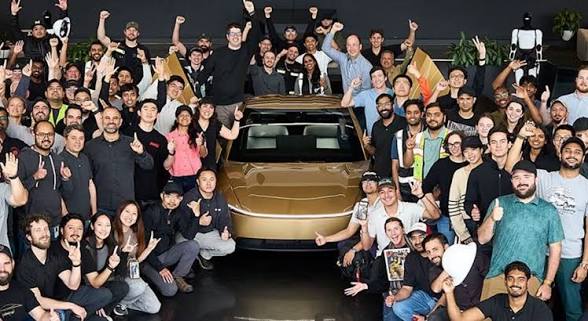
In February, Tesla shared an image from its Giga Texas factory showing employees gathered around a Cybercab with the caption “First Cybercab off the production line at Giga Texas,” signaling that the project had moved from design to manufacturing.
Regulatory approval remains a major hurdle. Authorities in the United States and other markets will need to sign off on fully driverless operations, and safety advocates continue to scrutinize Tesla’s autonomous claims. For now, the start of Cybercab production marks a symbolic but significant step toward Musk’s vision of a driverless Tesla fleet.