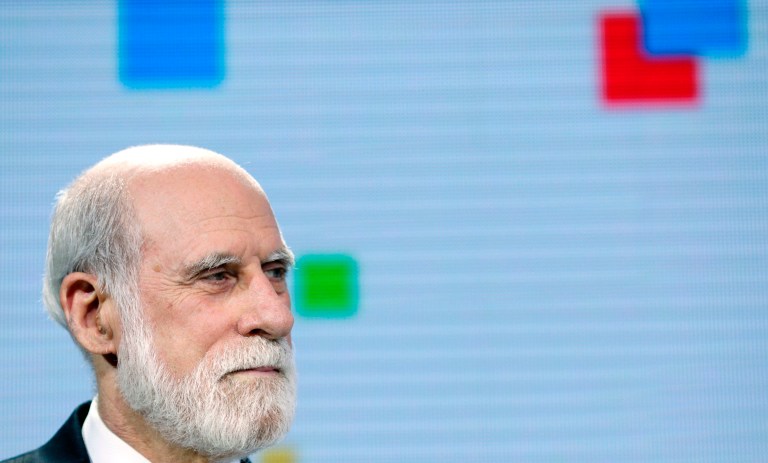
Vinton Cerf, long celebrated as one of the “fathers of the internet,” is stepping down from his role as Google’s chief internet evangelist, closing a chapter on one of the most consequential careers in modern technology.
The news emerged during the Open Frontier conference hosted by the Laude Institute, where Cerf appeared via video link. Dave Patterson, the UC Berkeley computer architecture pioneer, paused a panel discussion to acknowledge Cerf’s impending retirement and his more than two decades at Google, prompting a standing ovation from the audience of researchers, founders, and engineers.
Cerf and his collaborator Robert Kahn designed the TCP/IP protocols that underpin the global internet, enabling disparate computer networks to interconnect and scale. That work, begun in the 1970s, transformed from an academic experiment into the backbone of the digital world, earning Cerf the Presidential Medal of Freedom, the Turing Award, and a long list of international honors.
At Google, where he has served as vice president and chief internet evangelist since 2005, Cerf became a kind of roaming ambassador for open standards, accessibility, and the social responsibilities that come with global connectivity. His title, once a curiosity, came to symbolize the company’s early belief that a thriving, interoperable internet would ultimately benefit everyone, including its own business.
Onstage at Open Frontier, Cerf joined Patterson, François Chollet, John Ousterhout, and Matei Zaharia to discuss how to build open source systems that endure. The conversation quickly turned to artificial intelligence and whether the next era of computing will repeat the open, protocol-driven evolution of the early internet or consolidate power in a few corporate labs.
Cerf argued that the rise of autonomous AI agents will inevitably push the industry back toward shared technical standards. As software agents from different organizations begin to negotiate, transact, and collaborate, he said, they will need precise, formal languages and protocols, not just natural language exchanges.
English, Cerf warned, is too ambiguous for high-stakes machine-to-machine coordination. He likened a world of AI agents chatting loosely in human language to the childhood “telephone game,” where a whispered message mutates beyond recognition as it passes from person to person. In an agentic economy, such drift could be catastrophic.
In a lighter moment, Patterson recalled first meeting Cerf as a graduate student in the 1970s and being struck by his three-piece suits amid a sea of T-shirts and long hair. Cerf laughed, admitting he dressed formally precisely to stand out. It was a small, human detail about a man whose work quietly reshaped how the world connects.