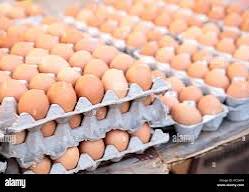
The Lagos chapter of the Poultry Association of Nigeria has dismissed reports of egg scarcity in the state, insisting that supplies are not only stable but abundant, with prices currently lower than many residents might expect.
In an interview with the News Agency of Nigeria, the Lagos State chairman of the association, Mojeed Iyiola, said narratives of widespread egg shortages in parts of the state do not reflect the reality on poultry farms or in major distribution hubs.
According to him, poultry farmers across Lagos are producing enough eggs to meet demand, and in some cases are even taking deliberate steps to prevent a glut in the market by selling at reduced prices.
“I want to say there are eggs available in Lagos presently. There is no scarcity of eggs in Lagos,” Iyiola said, stressing that any pockets of scarcity being reported are more likely linked to financial constraints among traders than to an actual shortfall in production.
He explained that some retailers who claim they cannot access eggs may simply be unable to restock because they owe their suppliers, who in turn are reluctant to extend further credit. This, he suggested, can create the impression of scarcity in certain neighbourhoods even when warehouses and farms are well stocked.
“So in places where they are witnessing scarcity of eggs I don’t think it’s a natural scarcity. Probably they have paucity of funds and could not buy the products, but there are eggs available,” he said.
To underscore the point, Iyiola disclosed that poultry farmers in Lagos recently embarked on a coordinated sale of eggs across the state’s eight poultry zones, offering crates at what he described as “ridiculously low prices” to keep the market balanced.
He said crates of eggs were sold for between ₦4,800 and ₦5,000, compared with the usual farm-gate price range of ₦4,900 to ₦5,200 per crate. The move, he explained, was a strategic decision by farmers to avoid a situation where oversupply would force them to waste unsold produce or sell at a loss.
“We recently displayed crates of eggs virtually across the eight zones we have in Lagos from the end of December till the new year at low prices. We sold the crates between ₦4,800 to ₦5,000 as against the usual farm gate price of ₦4,900 to ₦5,200 per crate just to ensure we did not experience egg glut,” he said.
The association’s position comes against a backdrop of rising concern among consumers about food prices and availability, particularly in urban centres like Lagos where inflation and transport costs have pushed many staples beyond the reach of low-income households. Eggs, a relatively affordable source of protein, are closely watched as an indicator of both food security and the health of the poultry sector.
Iyiola acknowledged that the poultry industry has faced significant challenges in recent years, including high feed costs, energy expenses and currency pressures that affect the price of imported inputs. However, he maintained that, at present, these pressures have not translated into a shortage of eggs in Lagos.
Instead, he credited a recent intervention by the Lagos State government with helping to stabilise prices and keep eggs within reach of consumers. Under that intervention, he said, poultry farmers received support on the condition that they would help drive down the retail cost of eggs and other poultry products.
“For now, there is no scarcity of eggs, and we have been selling at a reasonable price for a while now because we had an intervention from the Lagos State government and our agreement was to force the price down,” he explained.
Although that particular intervention has since been paused, discussions are ongoing about a fresh round of support targeted at the Easter season, when demand for both eggs and chicken typically rises sharply.
Iyiola said the association is optimistic that if the government renews its backing, consumers could see further price reductions around that period.
“Although the intervention has been stopped for now, the government is contemplating giving us more intervention so as to drop the price of poultry produce during the Easter period,” he said.
“If that is done, then we are going to have a subsidised rate for chicken as well as eggs during the Easter celebration.”
The chairman’s comments highlight the delicate balance poultry farmers must strike between covering their production costs and keeping prices affordable for consumers. While farmers are wary of selling below cost, they are also conscious that a glut can be just as damaging as a shortage, leading to waste and financial losses.
By coordinating sales and working with government on targeted interventions, the association is attempting to smooth out the sharp price swings that often accompany festive seasons and supply disruptions.
Industry observers note that Lagos, as Nigeria’s commercial hub, plays a central role in the country’s poultry value chain. Eggs produced in peri-urban and rural parts of the state are trucked daily into markets, supermarkets and food service outlets, while traders from neighbouring states also source supplies from Lagos farms.
.jpeg?alt=media&token=96b327a5-8e62-4ed1-a078-308aff149ed1)