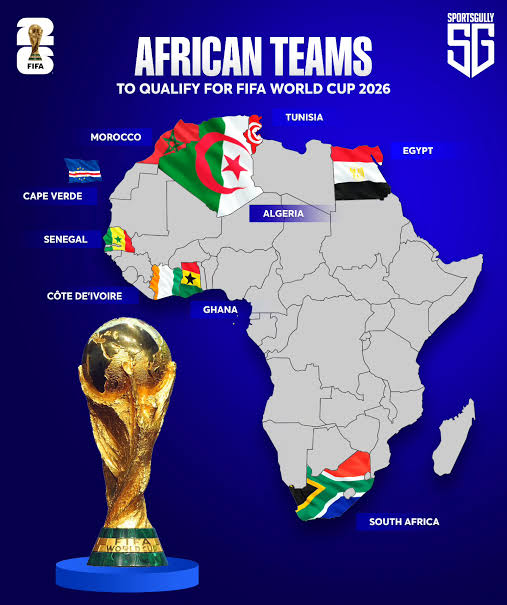
For much of World Cup history, Africa existed on the margins, its footballing story reduced to cameos and curiosities. The 2026 tournament changes that. With a record 10 African teams qualifying, participation has finally begun to look like presence.
To understand the significance of 10, you start with one. In 1934, Egypt crossed the Mediterranean to Italy as the continent’s lone representative, at a time when most of Africa was still carved into colonial parcels. Egypt lost 4-2 to Hungary in Naples, Abdelrahman Fawzy scoring twice and, Egyptians insist, denied a legitimate third by an offside call only the referee seemed to see. Africa’s World Cup relationship began in a familiar cloud of injustice.
For decades after, Africa’s involvement was intermittent and conditional. Teams were sometimes forced to qualify through Europe or Asia, their geography bent to fit FIFA’s priorities. Even as independence swept the continent in the 1960s, FIFA offered Africa just half a World Cup place. CAF, under Abdel Aziz Moustafa, led a boycott that forced the game’s rulers to confront a new political reality.
By 1970, Africa had one guaranteed slot. Morocco went to Mexico and competed, not merely appeared. Zaire’s heavy defeats in 1974 were seized upon to reinforce stereotypes: African teams were athletic but naive, passionate but undisciplined. Players were exoticised and renamed, their brilliance filtered through racialised nicknames rather than understood on its own terms.
Yet the football kept evolving. Algeria’s 1982 win over West Germany was wiped out by the “Disgrace of Gijon.” Cameroon’s run to the 1990 quarterfinals, powered by Roger Milla’s irreverent genius, forced the world to pay attention. Nigeria dazzled in 1994, Senegal stunned France in 2002, Ghana came a penalty kick away from the semifinals in 2010. Each tournament brought a moment, but not yet a sustained bloc of power.
Morocco’s 2022 semifinal run in Qatar shifted that perception again. They did not play like gate-crashers but like contenders, eliminating Belgium, Spain and Portugal with tactical clarity and emotional steel. Their success symbolised decades of investment and organisation, and it cracked the glass ceiling that had long contained African ambition.
Now, with 10 African teams at a 48-nation World Cup, the continent contributes more than isolated storylines. It brings a chorus of styles, histories and philosophies. Expansion has turned invitation into influence. Africa is no longer simply present at the World Cup; it is part of defining what the World Cup is.