Name: Vincent Happiness Ojima
Matric number: 230902053
Artificial Intelligence as a Personal Learning Assistant for Students
Artificial Intelligence (AI) is no longer a distant concept limited to science fiction. In today’s world, AI has become part of everyday life, including education. One of the most significant ways AI is being used in education is as a personal learning assistant. This form of technology supports students by helping them understand concepts, practise skills, and manage their studies more effectively.
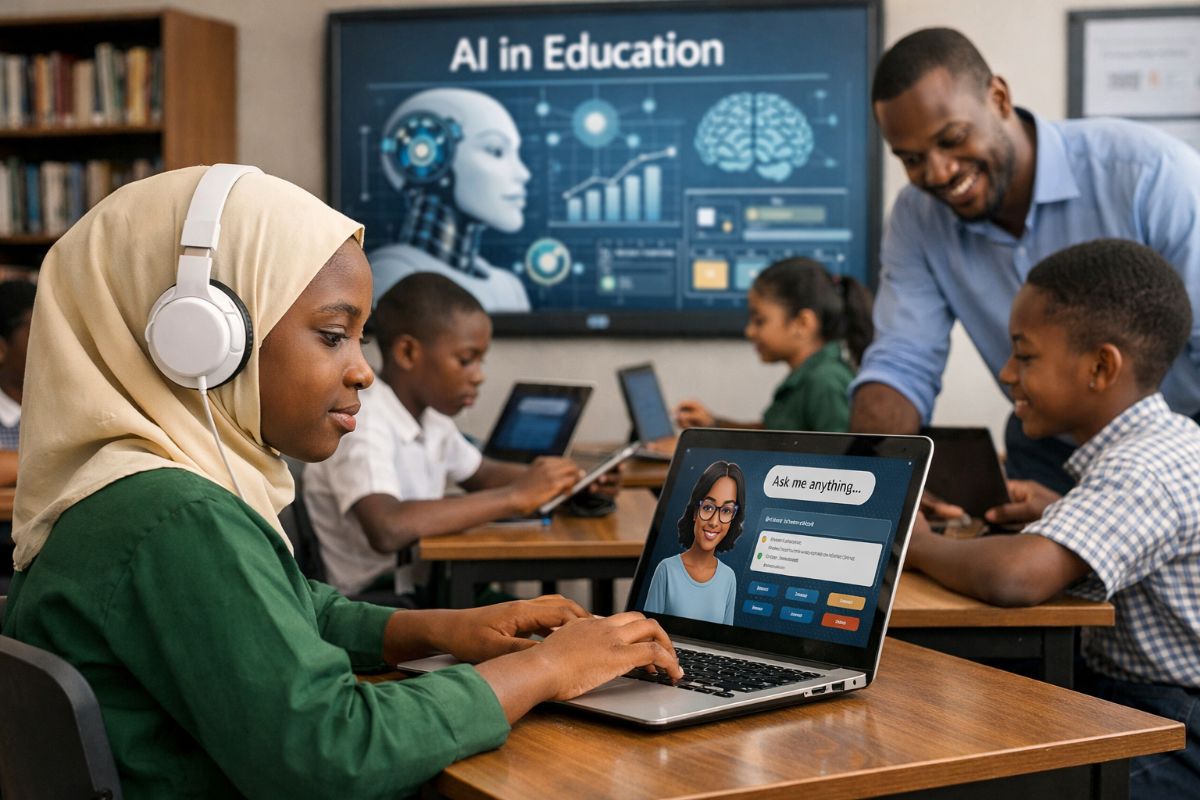
A personal learning assistant powered by AI is a digital tool that interacts with students in a way similar to a tutor. These assistants can be found in educational apps, learning websites, and virtual classrooms. They help students by answering questions, explaining difficult topics, and providing instant feedback. Unlike traditional classroom learning, where a teacher may not always have enough time to attend to every student, AI learning assistants are available at any time.
One major advantage of AI learning assistants is individualised learning. Every student learns differently, but in many classrooms, lessons are taught at a general pace. AI systems are designed to observe how a student learns, identify areas of difficulty, and suggest personalised content. For instance, if a student repeatedly makes mistakes in a particular topic, the AI assistant can recommend extra exercises or simplified explanations. This helps students build confidence and improve gradually.
AI learning assistants also support self-paced learning. Students are not forced to keep up with others or feel left behind. They can learn when it is convenient for them and revisit lessons as many times as necessary. This is especially useful for students who combine education with work or other responsibilities. In Nigeria, where issues such as power supply and school overcrowding affect learning, AI tools can provide flexible alternatives for studying.
Another important role of AI learning assistants is academic support outside the classroom. Students often have questions after school hours, but may not have access to teachers or tutors. With AI-powered chatbots and educational platforms, students can receive explanations, summaries, and practice questions instantly. This reduces reliance on expensive private lessons and promotes independent learning.
However, the use of AI as a personal learning assistant is not without challenges. One concern is over-dependence on technology. When students rely too much on AI to provide answers, they may reduce their ability to think critically or solve problems on their own. Learning should involve understanding concepts, not just receiving ready-made solutions.
Another challenge is limited access to digital tools. Many students, especially in rural areas, still lack reliable internet access or digital devices. This limits the widespread use of AI learning assistants and may increase educational inequality. There is also the issue of data privacy, as these systems collect information about students’ learning behaviour, which must be protected.
In conclusion, Artificial Intelligence as a personal learning assistant has the potential to improve the quality of education by making learning more personalised, flexible, and accessible. While challenges such as digital inequality and over-reliance exist, proper guidance and responsible use can help maximise the benefits. When combined with traditional teaching methods, AI learning assistants can support students in achieving better learning outcomes and preparing for a technology-driven future.