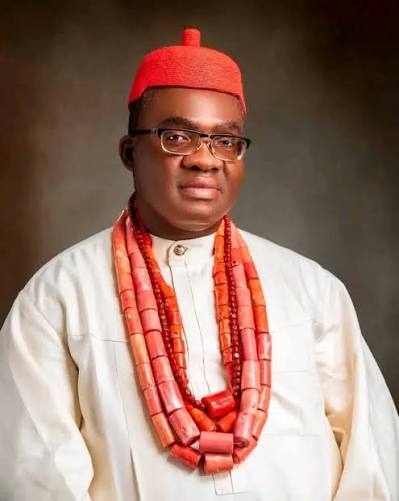
The ancient Ogwashi-Uku Kingdom is on fire again – at least online – as the Palace of His Majesty Obi (Dr) Ifechukwude Aninshi Okonjo II comes out swinging against a fresh round of explosive allegations: murder, kidnapping, criminal conviction, and shady land deals.
In a combative statement, the Palace Communications Directorate dismissed the accusations as nothing more than recycled lies, insisting they had already been torn apart and discredited before a Delta State Government Commission of Inquiry.
According to the Palace, this is not a random outburst but a calculated media war. The new wave of online attacks is being portrayed as a coordinated smear campaign allegedly sponsored by those who once cashed out massively from irregular sales of communal land in Ogwashi-Uku.
The Palace is leaning heavily on the credentials of the monarch, repeatedly stressing that Obi Ifechukwude is not just any traditional ruler but a doctorate holder in Economics and Finance from the University of Edinburgh and the Paris Business School, and the younger brother of WTO Director-General and former Nigerian finance minister Ngozi Okonjo-Iweala.
Behind the royal image is an aggressive land recovery drive. The Palace boasts that under the Obi’s watch, more than 2,800 hectares of land previously sold off or encroached upon have been clawed back through legal means, a move it says is designed to ensure the community – not private speculators – benefits from its land and natural resources.
But that same campaign, the Palace admits, has triggered serious backlash. Powerful interests who allegedly fed fat on communal land are now said to be fighting dirty, resorting to character assassination and sensational allegations to derail the reforms and weaken the throne.
Palace officials insist this is not the first time such claims have surfaced. They say similar accusations were “resoundingly refuted and rubbished” during earlier inquiry proceedings, yet they keep reappearing online in what the Palace brands a desperate attempt to undermine the traditional institution.
One of the loudest critics in the current storm is social media activist Victor Ojei, popularly known as Wong Box. He has accused the Palace of selling communal lands to Chinese nationals and other foreign buyers. The Palace is not taking that lightly, flatly denying the claims and confirming that legal proceedings have been launched against him for alleged cyberstalking, false publication, and character assassination.
To shore up its position, the Palace is parading a string of court victories. In Suit No. O/5/2006, it says about 1,349 hectares originally set aside by the late Obi Prof. Chukwuka Okonjo for the proposed Anioma University of Science and Technology were recovered via a Warrant of Possession.
In another case, Suit No. O/50/2021, a High Court reportedly reaffirmed the Obi’s overlordship over roughly 900 hectares behind Delta State Polytechnic, Ogwashi-Uku, ordering that the land be recovered from alleged encroachers.
The Palace narrative is clear: the Obi is the lawful custodian and trustee of communal land, holding it in trust for the people. Any talk of him ceding land to politically exposed persons is branded as false. As proof, officials point to Suit No. O/163/2025, where the Obi is in court challenging alleged unauthorized transfers linked to a senior government figure, arguing it makes no sense to accuse him of selling land to someone he is actively suing.
Trying to calm fears among locals, the Palace insists that its land recovery drive is not aimed at ordinary farmers or vulnerable indigenes but at speculators and beneficiaries of dubious transactions. It claims that recovered land is being reserved for hospitals, schools, agriculture, industry, and other public infrastructure, and that nearly 2,000 indigenes have already received free land allocations.
In the end, the Palace is betting everything on the courts and public perception. It is urging Ogwashi-Uku indigenes and the wider public to ignore what it calls malicious propaganda and to rally behind the throne’s push to protect communal heritage and secure “sustainable development” for future generations.
For now, the battle lines are drawn: on one side, a Palace painting itself as reformist and under attack; on the other, vocal critics accusing the royal institution of exactly what it denies. The court of public opinion is watching.