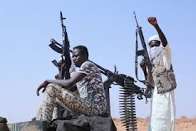
The United States is pressing the United Nations Security Council to impose sweeping new sanctions on Sudan’s warring factions, seeking to choke off foreign military support and push the Sudanese army and the paramilitary Rapid Support Forces into serious peace talks.
US adviser for Arab and African affairs Massad Boulos told the council that outside financial, military and political backing is prolonging a war that has killed tens of thousands and uprooted some 13 million people, turning Sudan into one of the world’s worst humanitarian crises.
Washington’s draft resolution would extend the UN arms embargo, currently limited to Darfur, to all of Sudan. It would cover every armed actor in the country and explicitly ban the transfer of drones and related technologies, which have become central to the conflict.
The text also urges all states to halt any direct or indirect logistical, financial or military assistance that enables the fighting to continue. While the United States did not name specific governments, Egypt has publicly aligned with Sudan’s regular army, and the United Arab Emirates has repeatedly rejected accusations that it supplies weapons to the RSF.
UN political chief Rosemary DiCarlo told the council that the war has unleashed “a devastating humanitarian crisis,” with entire communities emptied by violence, hunger and fear. Around 13 million people have fled their homes, including millions displaced within all 18 of Sudan’s states.
UN human rights monitors recorded about 1,400 civilian deaths in the first half of the year alone, roughly 1,100 of them from drone strikes. DiCarlo said mass killings, abductions of women and girls and widespread sexual violence remain “recurring features” of the conflict, with hundreds of documented victims and many more believed to be unreported.
Drones used by both sides have repeatedly hit markets, schools, fuel depots and water facilities, she warned, while ground battles have intensified in North Kordofan, West Darfur, North Darfur and Blue Nile despite the rainy season.
Sudan’s UN ambassador, Al-Harith Idriss Al-Harith Mohamed, questioned why broader sanctions should be imposed on the country instead of narrowly targeting those responsible for atrocities. Army chief General Abdel-Fattah Burhan has likewise dismissed sanctions as leverage, vowing to keep fighting until all RSF-held areas are retaken.
The war erupted after a power struggle between Burhan and RSF commander General Mohamed Hamdan Dagalo, known as Hemedti, derailed Sudan’s fragile transition toward civilian rule. With ceasefire talks stalled, Washington is betting that tighter UN measures and a clampdown on foreign arms flows may be the only way to shift the rivals from the battlefield to the negotiating table.