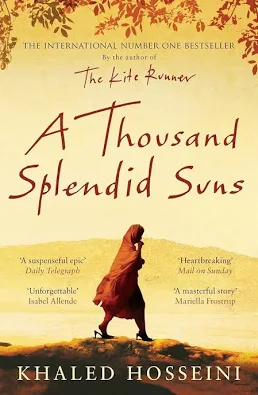
A Thousands Splendid Suns by Khaled Hosseini
Published by Bloomsburg Publishing in 2007
Chapters: 67 split into 4 parts
Pages: 228
Price: N12,500 or $9.22
Introduction
A Thousand Splendid Suns takes place mostly in two Afghan cities, Herat and Kabul, between the 1960s and 2000s. It is an emotional novel that examines the lives of two women during five different eras that Afghanistan experienced. The main themes of this work are familial dynamics, focusing primarily on women and their roles in contemporary Afghan society.
Summary of the book
The novel opens with the line, “Mariam was five years old the first time she heard the word harami.” Part One of the book starts during pre-Soviet Afghanistan. Mariam is introduced as a harami—a bastard, the illegitimate daughter of a wealthy man in Kabul. In this part, we see how Mariam’s background is shaped and how it follows her into marriage, which she was pressured into at the age of fifteen after her mother’s death. Her mother’s death leads to a change in her worldview, as she no longer sees her father as perfect; however, she also holds herself at fault for her mother’s suicide.
Mariam’s relationship with her mother, however, is not positive either, as Nana constantly ridicules her, always reminding Mariam of her birth circumstances. As Mariam puts it in the book, Nana made Mariam “another of her grievances against the world.” After marriage to Rasheed, a man in his forties, Mariam initially has a positive outlook on how Rasheed treats her. This later changes after she has a miscarriage, which by her seventh leads to Rasheed physically abusing her.
Part Two of the novel then follows Laila from when she was nine in Soviet Afghanistan. She navigates the relationships in her family, the strain between her parents, and the lack of connection she feels with her brothers, who have been away from home fighting for “jihad” since she was two years old. Her relationship with her mother grows even more distant after the news of her brothers’ deaths.
After Laila is orphaned and also married to Rasheed, she and Mariam initially begin as enemies; however, when she disappoints Rasheed by bearing him a girl, she becomes a target of his abuse too. This fosters a friendship between two women of two different generations, who face other atrocitie and cruelties later parts together such as the atrocities of the Taliban.
My thoughts on the novel
The novel examines difficult topics that might be hard to read for most: gender inequality, suicide, family dilemmas, war, child marriage, Islam, politics, feminism, and even classism to an extent.
For a large part of the book, the actions of men are left without any sense of actual consequences. This supports an idea stated by Nana in the quote, “Learn this now and learn it well, my daughter: like a compass needle that points north, a man’s accusing finger will always find a woman.” This can be seen with Nana and Jalil’s relationship, as well as Mariam and Rasheed’s, where he always finds fault with whatever she does, and later, Laila and Rasheed's.
A Thousand Splendid Suns is a complex story that appears simple, but is a representation of culture, politics, family, trauma and much more in the life of two women. It might be seen as a feminist book, even though the closest to modern feminist ideology as we know it today only really begins to surface or rather attention is focused on is in Part Two through Laila’s teacher, Shanzai, who also carries out propaganda for the Soviet Union and against America.
Another thing is the way mother-daughter relationships are covered in the novel is also unique. We see how the emotional and mental states of women affect their bonds with their daughters. However, we also see how motherhood is viewed by Mariam, as she goes through seven miscarriages, which changes when she begins to see Laila as her daughter.
Conclusion
Personally, this was a read that really made me understand the meaning of how oppressive and abusive behaviours of men can be enabled by their society. The harm that traditions that supports oppression can do to a society. It showed me a perspective of war that I had not considered thoroughly or emotionally. However, it also underlined the importance of healthy family bonds and friendship. This work also definitely feels different to me, consideration the current situation of Afghanistan.
A quote that resonated deeply with me from the novel as a Nigerian is when Hakim, Laila’s father, said, “To me, it is nonsense—and a very dangerous nonsense at that—all this talk of I’m Tajik and you’re Pashtun and he’s Hazara, and she’s Uzbek; we are all Afghans, and that’s all that should matter.” Nigeria’s current state is similar: chaos, but people still care more about labels that cause division and no solutions to the issues that tear us apart even further.