The Gaza Strip lies shattered, its neighborhoods flattened and its basic infrastructure in crisis. Water and sewage systems are barely functioning, roads and power grids are broken, and aid agencies warn that food production and distribution remain dangerously fragile. Yet in the middle of this devastation, world soccer’s governing body has stepped forward with a strikingly different promise: a gleaming new national stadium.
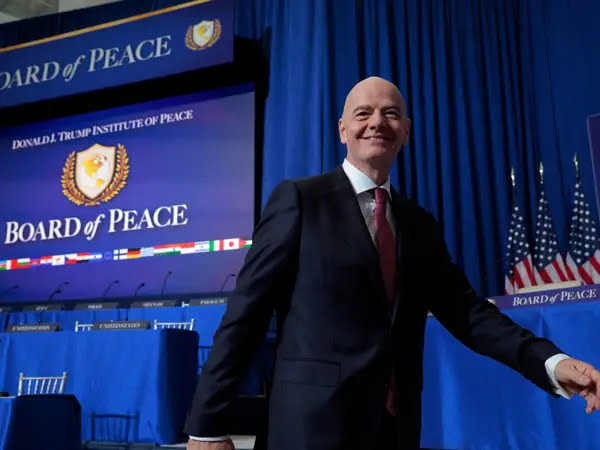
FIFA president Gianni Infantino announced that the organization will commit $50 million to build a modern arena in Gaza, designed to hold between 20,000 and 25,000 spectators. The pledge came during a high-profile gathering of the so-called Board of Peace in Washington, where governments discussed a multibillion-dollar relief and stabilization package for the territory after years of war between Israel and Hamas.
Infantino framed the project as an investment not just in concrete and steel, but in the emotional recovery of a traumatized population. “We don’t have to just rebuild houses or schools or hospitals or roads,” he said. “We also have to rebuild and build people, emotion, hope and trust. And this is what football, my sport, is about.”
Beyond the stadium, FIFA promised a $15 million football academy in Gaza, plus $2.5 million for 50 “arena mini pitches” scattered through communities. Five full-sized fields, at $1 million each, are also part of the package, forming what FIFA describes as the backbone of a “complete football ecosystem” for youth, amateur and regional competition.
Gaza itself does not field a separate national team. Instead, players from the enclave are eligible for the unified Palestinian side, which represents both Gaza and the West Bank and has been recognized by FIFA since 1998. The team has yet to reach a World Cup, but football remains one of the few shared passions that can cut across borders and political divides.
Infantino leaned heavily on that symbolism, calling football “the world’s universal language” and “a bridge toward peace, dignity and hope.” A promotional video shown at the event depicted children playing on dusty fields and promised Gaza leagues at multiple levels, under the slogan: “A simple ball. A shared field. A reason to believe again.”
Whether a state-of-the-art stadium can coexist with shattered infrastructure and unresolved political tensions remains an open question. For now, FIFA is betting that in a place defined by loss, the promise of a future match under floodlights can itself be a form of reconstruction.