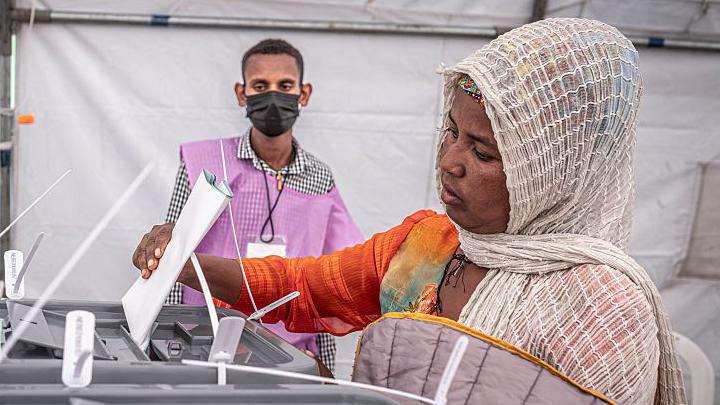
Vote counting is still under way across large parts of Ethiopia after a high‑stakes general election widely expected to cement Prime Minister Abiy Ahmed’s Prosperity Party in power, but overshadowed by insecurity and the exclusion of key regions.
Election officials say tallies are incomplete in Sidama, Gambella, Amhara and the Somali region, with counting also continuing in many districts of the capital, Addis Ababa. The National Election Board reported that long queues and logistical delays forced voting to be extended late into the night, slowing the work of local counting centres.
“Vote counting has not yet been completed in the Sidama, Gambella, Amhara and Somalia regions, and largely remains ongoing in Addis Ababa,” said board chairperson Melatework Hailu, who attributed the backlog to heavy turnout and the late closure of polling stations. She said counting teams were still working through stacks of ballot papers.
The vote unfolded under a heavy security presence, particularly in Addis Ababa and in parts of Oromia and Amhara, where armed conflict and sporadic attacks have intensified in recent years. Hailu confirmed that security incidents disrupted polling in both regions, forcing temporary closures at some stations and the complete suspension of voting at 143 others.
“There is nothing new at this time regarding polling stations that have not opened and where voting has not yet taken place due to security issues. The situation remains as it is,” she said, leaving thousands of would‑be voters uncertain whether they will be given another opportunity to cast their ballots.
Despite the disruptions, officials say voting proceeded relatively smoothly at around 50,000 polling stations nationwide. More than 500 seats in the House of Peoples’ Representatives are at stake, along with numerous regional and local council positions that will shape Ethiopia’s political landscape for years.
Domestic civil society groups and international observers from the African Union and the Intergovernmental Authority on Development monitored the process. The election board maintains that, overall, the vote was conducted in line with Ethiopian law and established procedures, and has promised to announce official results once counting and verification are complete.
Yet the credibility of the exercise is clouded by the continued absence of the Tigray region, which did not participate because of what organisers described as “unfavourable conditions” following a devastating two‑year civil war and ongoing political turmoil. Tigray has lacked representation in Ethiopia’s federal parliament for six years, underscoring the deep fractures that persist even as authorities seek to present the election as a step toward stability and democratic consolidation.