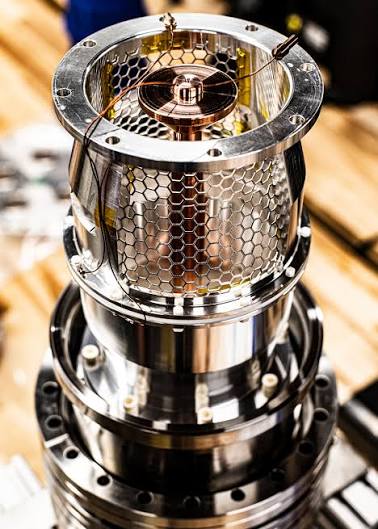
Nuclear fusion has long been associated with monumental machines and billion‑dollar facilities. is betting that the future of the field will fit on something closer to a lab bench than a football field.
Co‑founder and CEO Robin Langtry and his team have spent years developing what amounts to a desktop fusion device. By shrinking the hardware, they aim to speed up the learning cycle that has slowed fusion research for decades. Small systems are cheaper to build, easier to modify, and faster to test, allowing engineers to iterate in days instead of months.
Fusion’s promise is enormous. By fusing light atoms into heavier ones, reactors could generate vast amounts of carbon‑free energy using fuel derived from seawater and lithium. But the technical barriers are steep. Plasma must be heated to temperatures hotter than the Sun and confined long enough for atomic nuclei to collide and fuse, all while materials and components withstand extreme conditions.
Most fusion startups are pursuing large, complex machines. Commonwealth Fusion Systems is building powerful magnet‑wrapped tokamaks, while others fire immense laser arrays at tiny fuel pellets. Avalanche is taking a different route, using extremely high voltages to pull plasma particles into tight orbits around an electrode, with modest magnets providing additional control. As the particles accelerate and their orbits shrink, collisions become energetic enough for fusion reactions to occur.
The approach has attracted investors. Avalanche has raised about 80 million dollars, including a recent 29 million dollar round led by R.A. Capital Management with several climate and deep‑tech funds participating. In a sector where individual projects can cost billions, Avalanche’s comparatively lean funding underscores its small‑scale strategy.
Langtry’s experience at Blue Origin, the space company backed by Jeff Bezos, helped shape Avalanche’s philosophy. Borrowing from the rapid‑iteration playbook pioneered in commercial spaceflight, the company tweaks and tests its devices as often as twice a week, a cadence that would be prohibitively expensive with larger reactors.
Today, Avalanche’s reactor core measures just nine centimeters across. A forthcoming 25‑centimeter version is designed to reach about one megawatt of power and significantly improve plasma confinement, a key step toward achieving Q greater than one, where a reactor produces more power than it consumes.
Those experiments will run at FusionWERX, Avalanche’s commercial test facility, which it also leases to other fusion players. The company expects the site to be licensed to handle tritium, a crucial fusion fuel, later this decade. Langtry will not name a breakeven date, but he argues that by thinking smaller, Avalanche can move just as fast as far larger rivals.