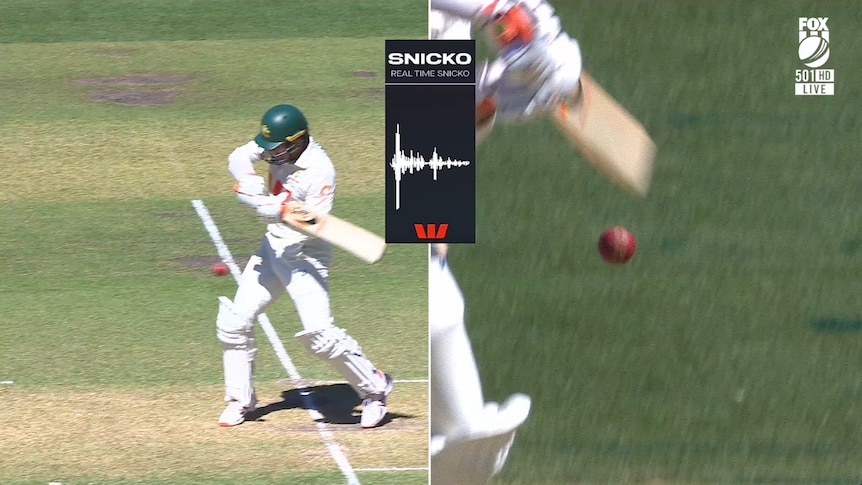
On the opening day of the third Ashes Test in Adelaide, a significant error involving the Snicko technology occurred during a review of an appeal against Australia’s Alex Carey. The incident has raised questions regarding the reliability of the decision review system (DRS) used in the series.
Alex Carey played a key role in Australia’s innings, contributing to a total of 326-8 at stumps. While on 72 runs, Carey was the subject of a caught-behind appeal by England off the bowling of Josh Tongue. The on-field umpire, Ahsan Raza, gave a not out decision. England opted for a review, citing a clear noise on television replays and a significant spike on the Snicko technology, which typically indicates contact between bat and ball.
Despite the available evidence, third umpire Chris Gaffaney upheld the not out decision. The justification provided was that the spike on Snicko appeared before the ball reached the bat, suggesting the noise was not caused by an edge. Subsequently, Carey admitted in a press conference that he believed he had edged the delivery.
BBG Sports, the company responsible for Snicko, later issued a statement accepting responsibility for the error. The company disclosed that the audio for Snicko analysis was incorrectly sourced from the stump microphone at the bowler’s end, rather than the correct end. This resulted in a delay and a misalignment between the audio spike and the video, which misled the third umpire.
BBG Sports stated: “Given that Alex Carey admitted he had hit the ball in question, the only conclusion that can be drawn from this is that the Snicko operator at the time must have selected the incorrect stump mic for audio processing. In light of this, BBG Sports takes full responsibility for the error.”
The incident has renewed scrutiny of the DRS technology, particularly in high-profile series such as the Ashes. England, trailing 2-0 in the five-match series, expressed dissatisfaction with the technology. England’s bowling coach, David Saker, indicated that the team might consider an official complaint, referencing ongoing concerns about the system’s reliability.
This is not the first instance of Snicko-related controversy in the series. In the first Test, England wicketkeeper Jamie Smith was given out caught behind despite a lack of alignment between the Snicko spike and the ball passing the bat. Officials explained that a two-frame gap between video and audio is possible, but the latest incident has increased scrutiny of such discrepancies.
Former England bowler Steven Finn suggested that repeated failures could result in Snicko being replaced in international cricket. He cited multiple incidents during the series as evidence of the technology’s unreliability.
Other cricketing nations, including England, use UltraEdge, a system considered more reliable in synchronizing audio and video for review decisions. The repeated issues with Snicko in this Ashes series have led to calls for its replacement with UltraEdge or similar technology in future series.
Commentator Michael Atherton noted that, given the evidence available, the third umpire was unable to overturn the on-field decision. He stated that the lack of synchronization between the spike and the ball passing the bat prevented a definitive conclusion.
As the Ashes series continues, the consequences of the Snicko error remain under discussion. The incident has prompted further examination of the technology and processes used to ensure accurate and fair decision-making in international cricket. Australia currently leads the series 2-0.