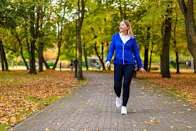
Walking is low impact, accessible, and free. But does walking build muscle?
In a study on global participation rates in sport, walking was found to be the most popular physical activity among adults in four of six global regions including the Americas. But are we accomplishing anything more than getting away from our desks for a few minutes?
What happens to our bodies when we walk?
“From a physiological perspective, walking is a whole body activity,” says Professor Brian Carson, exercise physiologist at the University of Limerick and head of science at Whole Supp. “When we walk we use our muscles to propel us, which increases our energy expenditure, thus increasing the metabolic demands placed on our muscles and the body as a whole.”
As with any exercise, our breathing speeds up in order to deliver more oxygen to our muscles. But, because walking is relatively steady state—i.e. not too taxing—we’re unlikely to get out of breath unless there’s an added stressor, like going uphill or at a faster pace.
There’s also a neurological effect. “Our brain and nervous system become more active as we take in and process sensory information from the environment around us and from the movement itself, while at the same time providing stimulatory output to the muscles in a coordinated sequence to help us move fluently,” says Carson
But does walking build muscle or not?
Gym lore has it that cardio kills gains as our bodies metabolize our muscles for energy. And it turns out that walking doesn't really build size—although Carson points out that in a study where step counts were reduced to below 1,500 steps per day, participants saw muscle protein synthesis reduced by 28%, even after a high protein meal, and significant reductions in leg lean mass. Another study found some walking was better than sitting all day. Ireland points to a third study which found that walking combined with resistance training is much more effective in maintaining muscle mass.
Rucking—more intense hiking wearing a weighted vest or backpack—can dial up the intensity of walking. “Rucking encourages the core and lower body to work harder, also increasing heart rate,” says Ireland.