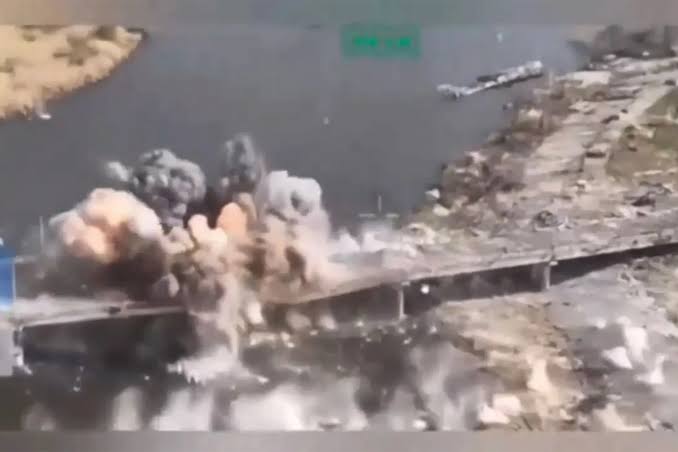
Russia has escalated its rhetoric against the United Kingdom after British-made drones were reportedly used by Ukrainian forces to strike a strategic bridge in Russian-occupied southern Ukraine.
The attack targeted a vital crossing over the Konka River in the Kherson region, a key supply route for Russian troops. Ukrainian forces are said to have deployed Malloy T-150 heavy-lift drones, capable of carrying substantial explosive payloads, to hit structural weak points on the bridge and disrupt Russian military logistics.
According to Ukrainian military sources, the crossing had previously survived repeated attempts to disable it, including precision strikes using HIMARS rocket systems. The successful use of heavy-lift drones underlined how unmanned systems are increasingly being used to achieve what conventional artillery and missiles have struggled to accomplish.
The reported involvement of British-manufactured drones triggered a furious response from prominent figures in Russian state media. Commentator Vladimir Kornilov accused the UK of directly enabling attacks on what Moscow claims as its own territory, framing the operation as evidence of London’s deepening role in the conflict.
In a pointed escalation, Kornilov and other pro-Kremlin voices floated the idea of retaliatory action against symbolic British infrastructure. Westminster Bridge in central London, a landmark adjacent to the Houses of Parliament, was singled out in commentary as a hypothetical target, presented as a mirror response to the strike on the Konka River crossing.
These threats were amplified by other Kremlin-aligned outlets, which called for a tougher stance against what they described as “decision-making centres” in Western countries. While such language has become a recurring feature of Russian propaganda, the explicit mention of a well-known London bridge marked a sharper, more personalised warning to the UK public.
British officials have not publicly confirmed operational details of the drones used in the strike, but the UK has acknowledged supplying Ukraine with advanced unmanned systems as part of its broader military support package.
For now, the threats against UK infrastructure remain rhetorical, with no evidence of concrete plans to target British territory. However, the episode underscores how the expanding use of Western-supplied technology on the battlefield is feeding a cycle of accusation and intimidation between Moscow and NATO capitals, raising concerns about potential spillover beyond Ukraine’s borders.