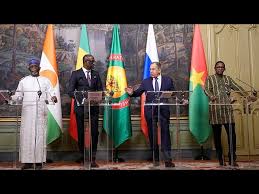
Russian Foreign Minister Sergei Lavrov met in Niamey with the foreign ministers of Burkina Faso, Mali and Niger, consolidating Moscow’s role as the principal external backer of the junta-led Alliance of Sahel States
In a joint statement issued after the talks, Russia and the three governments said Moscow would continue to bolster the alliance’s armed forces, pledging sustained support to strengthen their operational capabilities The commitment underscores how deeply Russia has embedded itself in the security architecture of the Sahel at a time when Western influence, particularly that of France and other European partners, has sharply receded
The Alliance of Sahel States was created by the military rulers of Burkina Faso, Mali and Niger after a series of coups between 2020 and 2023 The bloc has since withdrawn from regional structures aligned with Western partners and has expelled French troops and some European missions, accusing them of failing to stem a jihadist insurgency that has devastated large swathes of the region
Russian forces and Africa Corps paramilitaries are now central to the alliance’s counterinsurgency campaigns They provide training, equipment and on-the-ground support against jihadist groups linked to Al-Qaeda and the Islamic State organisation, which have killed tens of thousands of people and displaced millions across the Sahel
Lavrov’s visit to Niamey, following an earlier meeting in Moscow with the same counterparts, signals that the relationship is evolving beyond ad hoc security cooperation into a broader strategic partnership Diplomats from the region describe Russia as a partner that offers weapons, political backing and security assistance without the governance and human rights conditions often attached to Western aid
Beyond the battlefield, Moscow is seeking to entrench its presence through economic deals in energy and mining, sectors that are critical to the budgets of the three landlocked states Negotiations have focused on exploiting uranium, gold and other minerals, as well as potential cooperation on hydrocarbons and electricity generation
For the juntas in Ouagadougou, Bamako and Niamey, the partnership with Russia is presented as a path to sovereignty and a break from what they portray as decades of neocolonial dependence on France For Western governments, however, the deepening ties raise concerns about democratic backsliding, civilian protection and the long-term consequences of outsourcing security to foreign mercenary-style formations