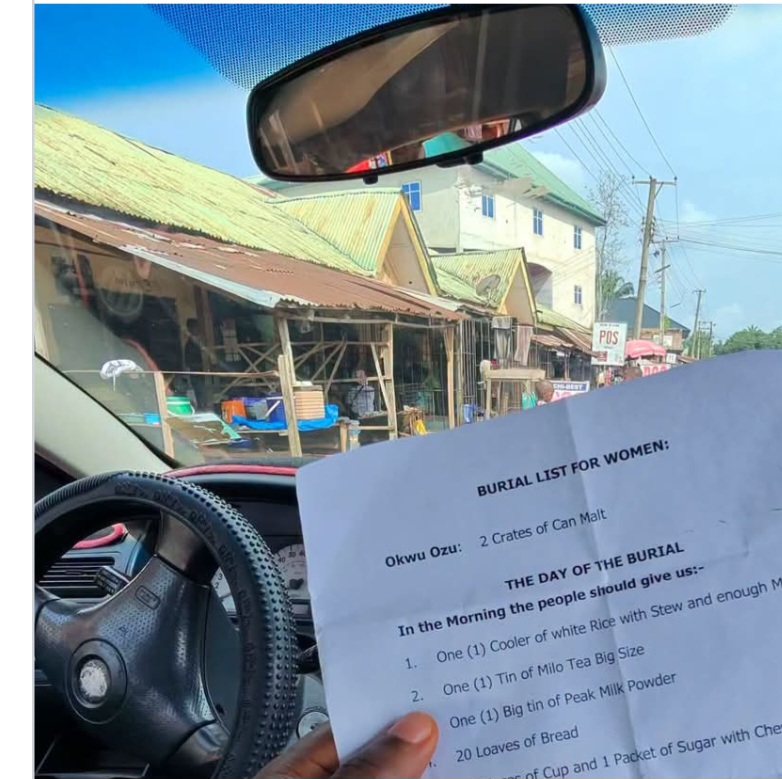
A grieving son has ignited a debate over costly burial customs after revealing the extensive list of demands his family received from village groups while preparing for his mother’s funeral.
Writer and coach Emeka Nobis, whose mother died after a prolonged cancer battle that he says drained the family of millions of naira, described how traditional expectations quickly added fresh pressure to their loss. Returning to his mother’s village with his brother, he said they were required to meet three distinct groups: the umunna, or men of the kindred; the umuada, women born into the kindred; and the alurudi, women married into the kindred.
According to Nobis, each group insisted on its own set of requirements before any meaningful discussion about the burial could proceed. One of the lists he shared showed demands dominated by food and drink for the groups’ refreshment, alongside livestock and other costly items. Because his mother died at 71, she was placed in what the community considers the highest category of death, triggering the expectation that the family must provide a cow.
The lists, posted on Facebook, drew strong reactions from social media users, many of whom questioned why a bereaved family should be burdened with such financial obligations at a time of emotional and economic strain. Commenters argued that customs meant to honor the dead now risked exploiting the living.
Nobis said he has tried to handle the negotiations calmly, describing the process as a form of project management that demands emotional intelligence. He stressed that his decision to document the experience is not to attack his culture, but to expose what he sees as unnecessary rituals and to encourage critical reflection.
He wrote that some burial practices in his part of Igboland no longer serve families already struggling with medical bills and grief. While acknowledging the importance of tradition and community, he insisted that culture is not static and can be modified when it harms rather than helps.
His account has become a rallying point for Nigerians who feel trapped between respect for ancestral customs and the harsh economic realities of modern life, renewing calls for communities to rethink how they honor the dead without impoverishing the living.





.jpeg?alt=media&token=96b327a5-8e62-4ed1-a078-308aff149ed1)


