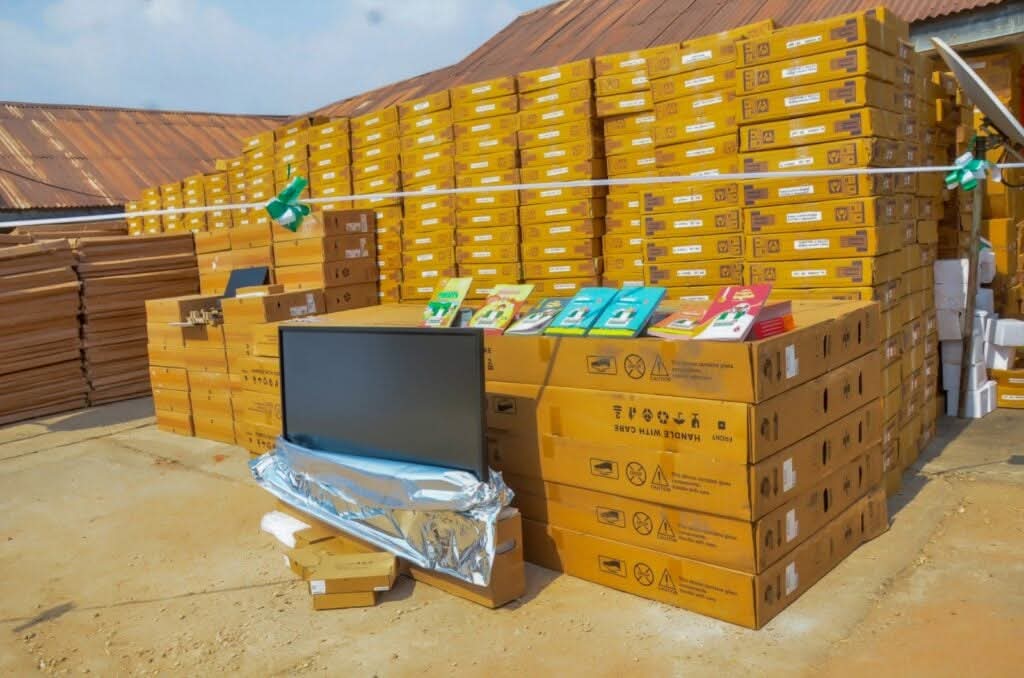
The Universal Basic Education Commission has launched a major distribution of teaching and learning materials to public basic schools across Benue State, in what education stakeholders describe as one of the most visible federal interventions in the state’s classrooms in recent years.
The exercise, flagged off at the Benue State Universal Basic Education Board headquarters in Makurdi, targets early childhood, primary and junior secondary schools. It is part of UBEC’s broader mandate to support states with critical resources that can improve the quality, inclusiveness and equity of basic education across Nigeria.
At the ceremony, the Executive Secretary of UBEC, Hajiya Aisha Garba, represented by the Commission’s North Central Director, Elder Edward Abalaka, said the intervention was designed to address a persistent gap in public schools: the chronic shortage of up-to-date instructional materials.
Garba stressed that no education reform can succeed if teachers and pupils lack the basic tools required for effective teaching and learning. She noted that while infrastructure and teacher training often receive attention, the simple availability of books, digital tools and classroom consumables remains a decisive factor in learning outcomes.
According to UBEC, the consignment to Benue includes smart boards, computers, English and Mathematics textbooks, Early Childhood Care and Education books, History books, storybooks, whiteboard markers and a range of other instructional materials tailored to the basic education curriculum.
Commission officials explained that the items were not randomly selected. They were chosen after needs assessments and consultations with state education authorities, with a view to aligning the materials with classroom realities and curriculum requirements. The goal, they said, is to ensure that what arrives in schools can be immediately deployed to improve teaching practice and pupil engagement.
Garba commended the Benue State Government for what she described as its consistency in accessing and utilising UBEC interventions. Under the UBEC model, states are required to provide counterpart funding and meet specific conditions before they can draw down on federal basic education funds and support. Benue’s ability to meet these conditions, she said, has made it possible for the state to benefit from successive rounds of intervention.
She added that UBEC would continue to work with the state to build a functional and effective basic education system, pointing out that the Commission’s role goes beyond one-off distributions. It includes planning support, monitoring, teacher development initiatives and the promotion of innovative approaches such as the integration of technology into classroom practice.
The Executive Chairman of Benue SUBEB, Dr Grace Adagba, was singled out for praise by UBEC for what the Commission described as efforts to reposition the board for improved efficiency. SUBEBs serve as the implementing arms of basic education policy at state level, and their capacity often determines whether federal interventions translate into real change in schools.
Education observers in the state say the new materials could make a tangible difference, especially in rural and underserved communities where pupils often share outdated textbooks or rely almost entirely on teachers’ verbal explanations. In many such schools, whiteboards and markers are either in short supply or completely absent, and digital tools like computers and smart boards are virtually unknown.
By introducing smart boards and computers into selected schools, UBEC and the state government are also signaling a gradual shift towards technology-enabled learning. While connectivity and power supply remain challenges in parts of Benue, officials argue that familiarising teachers and pupils with digital tools is a necessary step if the state is to keep pace with national and global trends in education.
The flag-off ceremony was performed on behalf of Governor Rev Fr Dr Hyacinth Iormem Alia by the Deputy Governor, Dr Sam Ode. In his remarks, Ode underscored the centrality of basic education to national development, describing it as the foundation upon which all other levels of learning and skills acquisition are built.
He pledged the state government’s commitment to safeguarding the materials and ensuring that they are properly deployed to public schools rather than diverted or left idle in storage. According to him, the administration is aware of past concerns about the misuse or poor tracking of educational resources and is working with SUBEB and local education authorities to strengthen accountability mechanisms.
Part of that effort, officials say, will involve clear documentation of what each school receives, periodic monitoring visits and feedback channels for head teachers and communities. The intention is to ensure that the materials reach classrooms, are used as intended and are maintained for as long as possible.
For teachers, the arrival of new textbooks and storybooks is expected to ease lesson preparation and broaden the range of activities they can offer pupils. Storybooks and History texts, in particular, are seen as tools for improving literacy, critical thinking and cultural awareness, while the focus on English and Mathematics reflects national concerns about low proficiency levels in core subjects.
Early Childhood Care and Education books are also part of the package, signaling attention to the earliest years of schooling. Education experts have repeatedly argued that interventions at the pre-primary and lower primary levels yield some of the highest returns, as they shape children’s readiness to learn and their long-term academic trajectories.
UBEC officials emphasised that the Benue intervention is one component of a nationwide effort to raise standards in basic education. Across Nigeria, the Commission has been supporting states with infrastructure projects, teacher training, instructional materials and special programmes aimed at reducing out-of-school numbers and improving equity for girls, children with disabilities and learners in hard-to-reach areas.