CONTINUOUS ASSESSMENT BY; Dr. Olufesi Suraj
Micro Story by: Omoboboye Damilola
300level/Mass communication
Andromeda — A Window to the Cosmos
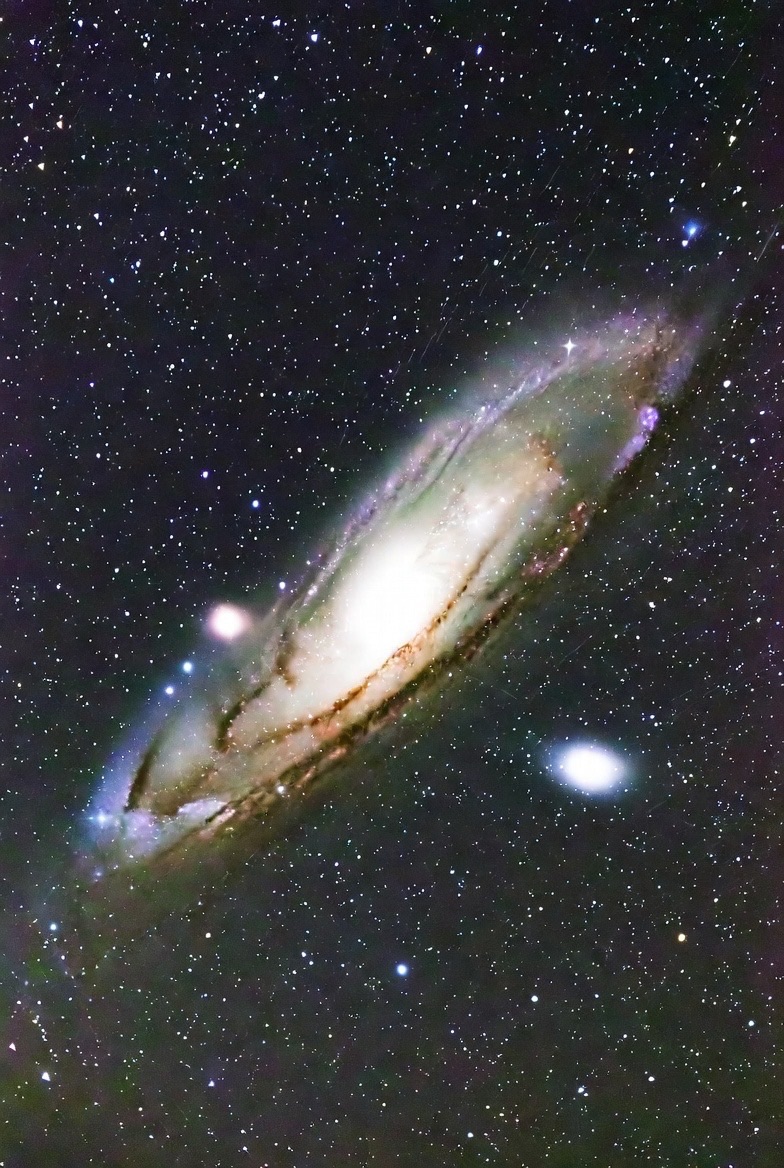
The Andromeda Galaxy, the closest large galaxy to our Milky Way, drifts silently across the night sky—a vast spiral of hundreds of billions of stars suspended in darkness, about 2.5 million light-years away. Every photon of light reaching our eyes tonight began its journey 2.5 million years ago, long before recorded history, long before cities, languages, or names. When we look at Andromeda, we are not seeing it now—we are seeing a memory of the universe.
That faint smudge in the sky, barely visible to the naked eye under dark conditions, is not a cloud or a trick of vision. It is an entire galaxy, larger than our own, holding star systems, planets, nebulae, black holes, and mysteries beyond counting. Each point of light within it could host worlds with stories of their own, unfolding in silence.
Astronomers tell us that Andromeda is racing toward the Milky Way at over 100 kilometers per second. In about 4 to 5 billion years, the two galaxies will begin a slow, graceful collision—not a violent crash, but a cosmic dance lasting hundreds of millions of years. Stars will pass by one another like ghosts, gravity reshaping both galaxies into something entirely new. The night sky, as we know it, will never be the same.
As physicist Brian Cox once said, “The universe is under no obligation to make sense to you.” Andromeda embodies that idea perfectly—order without intention, beauty without audience, motion without sound. It exists whether we look at it or not, yet somehow invites us to stare in awe.
To gaze at Andromeda is to confront time itself. It reminds us that the universe is ancient, vast, and indifferent—yet here we are, small and temporary, capable of curiosity and wonder. In that quiet connection between our eyes and a galaxy millions of years away, we find something profound: even in our smallness, we are part of the cosmic story.