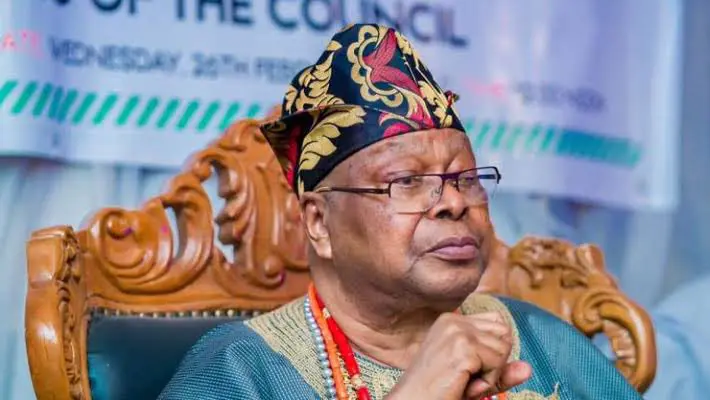
The revered Awujale stool of Ijebuland has turned into a full-blown royal scramble as an astonishing 95 members of the Fusengbuwa ruling house have thrown their hats into the ring, each insisting they are the rightful heir to one of Nigeria’s most powerful traditional thrones.
From 94 princes to a lone princess, the once-exclusive race has ballooned into what looks more like a crowded political primary than a solemn royal succession. The throne, left vacant after the death of Oba Sikiru Kayode Adetona at 91, is now the subject of intense lobbying, backroom maneuvering, and growing public drama.
The nomination exercise, held at Bisrod Hall in the Government Reserved Area of Ijebu Ode, was packaged as a strictly controlled, tradition-heavy process. Yet, behind the formalities, the sheer number of aspirants has raised eyebrows and fuelled speculation about power blocs, hidden sponsors, and quiet rivalries within the Fusengbuwa family.
Presiding over the marathon session was the Chairman of the ruling house, Otunba Abdulateef Owoyemi, flanked by his deputy, Prince Adedokun Ajidagba, and Vice Chairman, Professor Fassy Yusuf. Local government officials sat in as observers, giving the event a veneer of officialdom as name after name was pushed forward.
In a carefully choreographed ritual, no aspirant was allowed to simply stand up and declare ambition. Each had to be “packaged” by two relatives – one to propose, another to second – before being accepted. By the end of the day, 95 hopefuls had been endorsed, turning the Awujale stool into arguably the most hotly contested traditional position in recent memory.
The list reads like a roll call of influence and ambition: businessmen, professionals, and social heavyweights all lining up for a shot at the crown. Among them are Giwa Abiodun Onanuga, husband of a former Ogun State Deputy Governor, Yetunde Onanuga; eye specialist and Eye Foundation Hospital founder, Dr Kunle Hassan; and construction boss, Otunba Fatai Arowolo of Aron Construction. The only woman in the race, lawyer Mrs Oluwakemi Onanuga, stands out in what has long been a male-dominated arena.
Speaking to journalists, Owoyemi painted a picture of unity and order, insisting the process was peaceful despite the high stakes. According to him, the family relied on “extensive consultations” and traditional divination to guide the nominations, promising that whoever emerges will protect Ijebuland’s unity and progress.
He proudly announced that the family had “successfully and harmoniously” nominated 95 candidates and promptly shifted responsibility to the kingmakers, declaring that it was now their burden to pick just one. On paper, the family has done its part; in reality, the kingmakers now face a political minefield.
In a move clearly designed to pre-empt messy court battles and public embarrassment, Owoyemi revealed that all aspirants had signed an undertaking not to challenge the outcome in court. The pledge is being sold as a commitment to peace, but critics see it as an attempt to keep internal disputes away from public scrutiny.
The ruling house insists that everything is being done “by the book” – in line with the Ijebu chieftaincy declaration, Ogun State’s Obas and Chiefs Law, and established customs. The expectation being pushed is that a new Awujale will emerge “soon,” once the kingmakers complete their screening. But with 95 contenders and rising tensions, “soon” may be more optimistic than realistic.
Adding fuel to the fire is the celebrity angle: popular Fuji star, Alhaji Wasiu Ayinde Marshal, known as K1, dramatically inserted himself into the conversation by expressing interest in the Awujale stool. His move instantly turned a largely internal royal affair into a national talking point, sparking heated debates over lineage, eligibility, and whether fame can translate into traditional authority.
The Fusengbuwa ruling house quickly moved to shut that door, bluntly declaring that K1 is not a member of the family and therefore has no business in the process. The musician fired back through the courts, seeking an interim injunction to halt the selection. The High Court in Ijebu Ode refused, dismissing the application at that stage – but the legal drama was only just beginning.
K1’s legal team, led by Senior Advocate of Nigeria, Dr Wahab Shittu, later withdrew the suit, claiming they were re-strategising. The “re-strategy” soon became clear: Shittu penned a detailed petition to Ogun State Governor, Dapo Abiodun, alleging irregularities in the Fusengbuwa nomination process and questioning the credibility of the exercise.
The petition took direct aim at the family’s Public Relations Officer, Prince Adeleye Ademuyiwa, accusing him of issuing directives on screening and delegate nomination that allegedly contradict the chieftaincy declaration, the Obas and Chiefs Law, and even a prior letter from the Ijebu Ode Local Government. The document went further, alleging attempts to sideline certain family members and shut out K1, warning that the situation could snowball into a wider crisis if ignored.
The ruling house has publicly brushed off the petition. Vice Chairman, Professor Fassy Yusuf, confirmed receiving the letter but dismissed it as “misguided” and irrelevant to the ongoing process. According to him, the family is following due process and will not be distracted by what it sees as external noise.
Behind the polished statements and legal exchanges lies a fierce struggle over a throne that carries enormous cultural and political weight. Under the late Oba Adetona, the Awujale stool became a national power centre, with the monarch known for his bold views on governance and his influence in regional politics. Whoever takes his place will inherit not just a crown, but a platform.