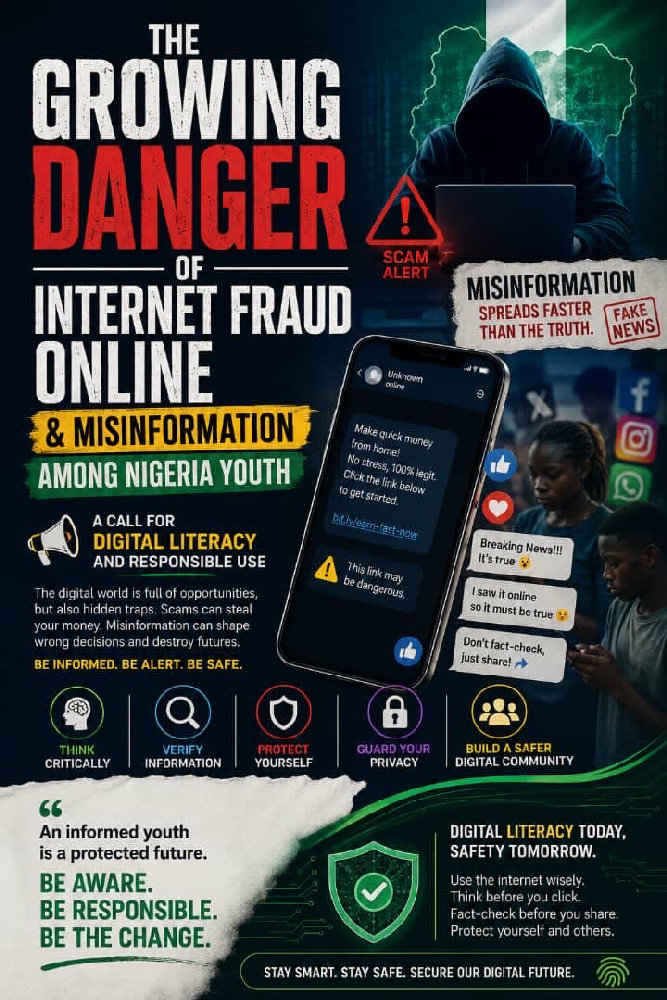
THE GROWING DANGER OF INTERNET FRAUD AND ONLINE MISINFORMATION AMONG NIGERIAN YOUTHS*
ABUJA — The National Information Technology Development Agency, NITDA, in partnership with the Nigerian Communications Commission, NCC, has warned Nigerian youths over the rising cases of internet fraud and online misinformation, describing it as a threat to national development and digital security.
The warning was issued during a two-day sensitization program held in Abuja. The event had in attendance students, teachers, parents, media professionals, and civil society groups. The theme was "Digital Literacy and Responsible Internet Use for a Safer Nigeria."
The Director General of NITDA said the internet has become essential for education, business, and communication, but criminals are also using it to defraud citizens and spread false information.
"The internet is no longer a luxury. It is a necessity," he said. "But with it comes responsibility. Many youths are falling victim to fraudsters who use social media, fake websites, and messaging apps to trap them."
He explained that internet fraud has gone beyond "Yahoo Yahoo" emails. Today, criminals use phishing, identity theft, romance scams, fake job offers, Ponzi schemes, and cloned banking websites. Youths aged 16 to 30 are the most targeted because they are the most active online.
"Daily, we get reports of students who lost school fees to fake scholarship adverts and graduates who paid for non-existent jobs," he said.
On misinformation, the NITDA DG said fake news spreads faster than the truth because it is designed to provoke emotion. He cited examples of false health claims, fake election results, and viral videos taken out of context.
"When misinformation goes viral, it can destroy reputations and incite violence," he warned. "Youths must learn to verify information before sharing."
An NCC official said the commission has set up a cybersecurity center to monitor and block fraudulent websites and phone numbers. He urged Nigerians to report suspicious messages by forwarding them to 2442.
"Technology can help, but we also need a change in mindset. We need digital literacy," he said.
Participants also shared experiences. A 200-level student of the University of Abuja said she lost ₦50,000 after clicking a link that promised free data. "The site looked like MTN's. I entered my card details and my account was emptied," she said.
A graduate said he was added to a WhatsApp group promising 200% investment returns in 48 hours. "My friends invested and lost everything," he said.
A teacher added that many students now get news from TikTok and Instagram without checking sources. "If a video has many likes, they believe it. We must teach media literacy," she said.
At the end of the program, five resolutions were made:
1. Make digital literacy and cybersecurity compulsory in schools.
2. Strengthen and enforce cybercrime laws.
3. Increase collaboration between government, telecoms, banks, and social media platforms.
4. Parents should guide children on responsible phone use.
5. Train youths as "digital ambassadors" to educate others on safe internet practices.
In his closing remarks, the NITDA DG said Nigeria must embrace the digital economy but also guard against its risks.
"The future is digital," he said. "If we use it for innovation and learning, it will create jobs. If we allow fraud and lies to dominate, it will destroy our youths."
He concluded: "Digital literacy today means safety tomorrow. Let us choose to be informed, responsible, and build a safer digital future for Nigeria."