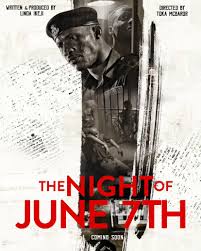
Nollywood is diving headfirst into one of Nigeria’s darkest police scandals and turning it into box-office bait with The Night of June 7th, a crime drama that puts actor Gideon Okeke front and center as the shiny “good cop” in a rotten system.
The film revisits the infamous Apo Six killings of 2005, when six young people were gunned down after being falsely tagged as armed robbers. But instead of dwelling on the victims or the public outrage, the movie packages the tragedy as a slick thriller about conscience, courage, and the supposedly heroic few inside the force.
Rather than fully confronting the horror of extrajudicial killings, The Night of June 7th zooms in on the police themselves, framing the story as an internal moral struggle. The message is clear and convenient: for every officer who breaks the law, there are others ready to risk it all to clean up the mess. It is a narrative that softens the institution while selling drama.
Gideon Okeke is positioned as the audience’s moral compass, playing a principled officer who dares to question what really happened that night. In the preview clip, he is the textbook “reluctant hero” – tense, brooding, and painfully aware of the dangers of challenging the system, yet too noble to walk away. Viewers are invited to see the crisis through his eyes, not through those of the dead or their families.
Surrounding him is a carefully assembled cast designed to give the film weight and credibility. Femi Branch appears as a senior officer whose loyalty is constantly under suspicion, the classic figure who might be either villain or victim of the system. Ali Nuhu plays the man stuck between angry citizens and official spin, embodying the tug-of-war between street reality and state narrative. Charles Lenny helps complete the picture of a police unit under the microscope, each character adding another layer to the “not all cops” storyline.
Directed by Toka McBaror, The Night of June 7th leans heavily on moody visuals: dark rooms, tense interrogations, and long silences meant to suggest deep moral conflict. The style is unmistakable: this is trauma repackaged as entertainment, with shadowy corridors and whispered threats standing in for the real chaos and fear that gripped the country when the case first broke.
The script pushes emotional beats hard: grieving families, terrified witnesses, and officers torn between loyalty and justice. But at its core, the film keeps circling back to one idea – that within a system widely seen as abusive, there are still noble men in uniform fighting the good fight. It is a comforting angle, and one that conveniently shifts focus from institutional rot to individual heroism.
The Night of June 7th clearly wants to be seen as a bold conversation starter about police accountability. Yet it does so by centering a “good cop” narrative that risks softening the brutality of state violence. The big question the film parades is simple and cinematic: when the truth itself becomes dangerous, who will dare to stand up for it? The bigger question it sidesteps is whether one heroic officer on screen can really balance out years of real-life bloodshed off it.