When Jay Li left Tesla’s Optimus humanoid robot program to found his own startup, he did not expect to spend his first year fighting a trade secrets lawsuit from his former employer. Tesla accused Li of taking confidential information to build Proception, a company focused on high-dexterity robotic hands. After months of legal sparring, the case has now been settled and dismissed, clearing a major cloud over the young company.
Li describes the ordeal as a “resilience test” that forced the team to stay focused while one of the world’s most aggressive corporate legal departments bore down on them. With the dispute behind him, he is turning fully to what he argues is a tougher challenge than any courtroom battle: giving robots hands that can truly rival a human’s.
Proception has announced an $11 million seed round led by First Round Capital, with participation from Y Combinator and BoxGroup. The funding will support both product development and scaling as the company begins shipping its first commercial units.
The startup is delivering an advanced robotic hand to researchers and robotics companies, positioning itself as a specialist supplier for organizations that want sophisticated manipulation capabilities without building them from scratch. In an industry racing to deploy humanoid robots in factories and warehouses, Li believes hands are the bottleneck.
While companies like Tesla promote ambitious timelines for humanoid robots on production lines, many experts say human-level dexterity is still years away. Li contends Proception can compress that timeline by rethinking how data for training robotic hands is collected.
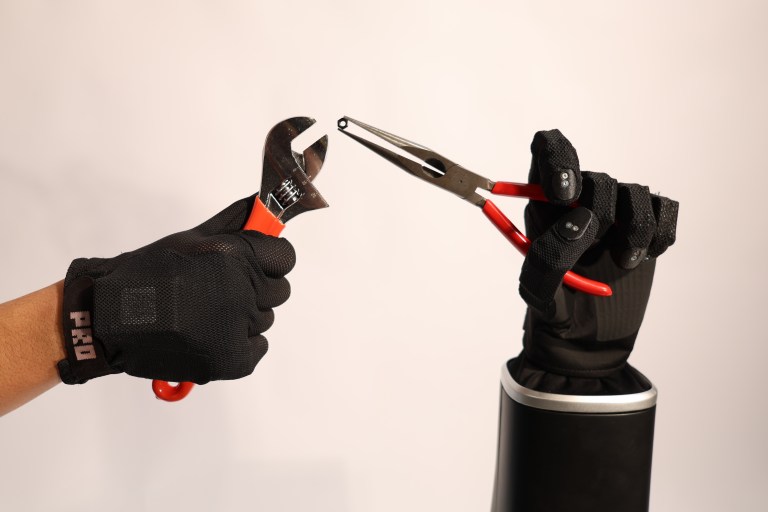
Instead of relying solely on teleoperated robots, where humans control machines through headsets and controllers, Proception uses a sensor-packed glove worn by human testers. The glove captures rich interaction data as people grasp, twist, and manipulate objects, without needing a robot present. The same glove can then be fitted over Proception’s robotic hand, acting as a tactile “skin” that feeds detailed feedback into the system.
The hand itself offers 22 degrees of freedom and multiple joints per finger, enabling a wide range of precise motions. Li argues that pairing this hardware with scalable, task-specific data collection is the key to cracking dexterous manipulation.
Investors are betting that this combination will make Proception the go-to provider of robotic hands for the emerging humanoid ecosystem. Li, for his part, believes that even Tesla may one day be a customer.